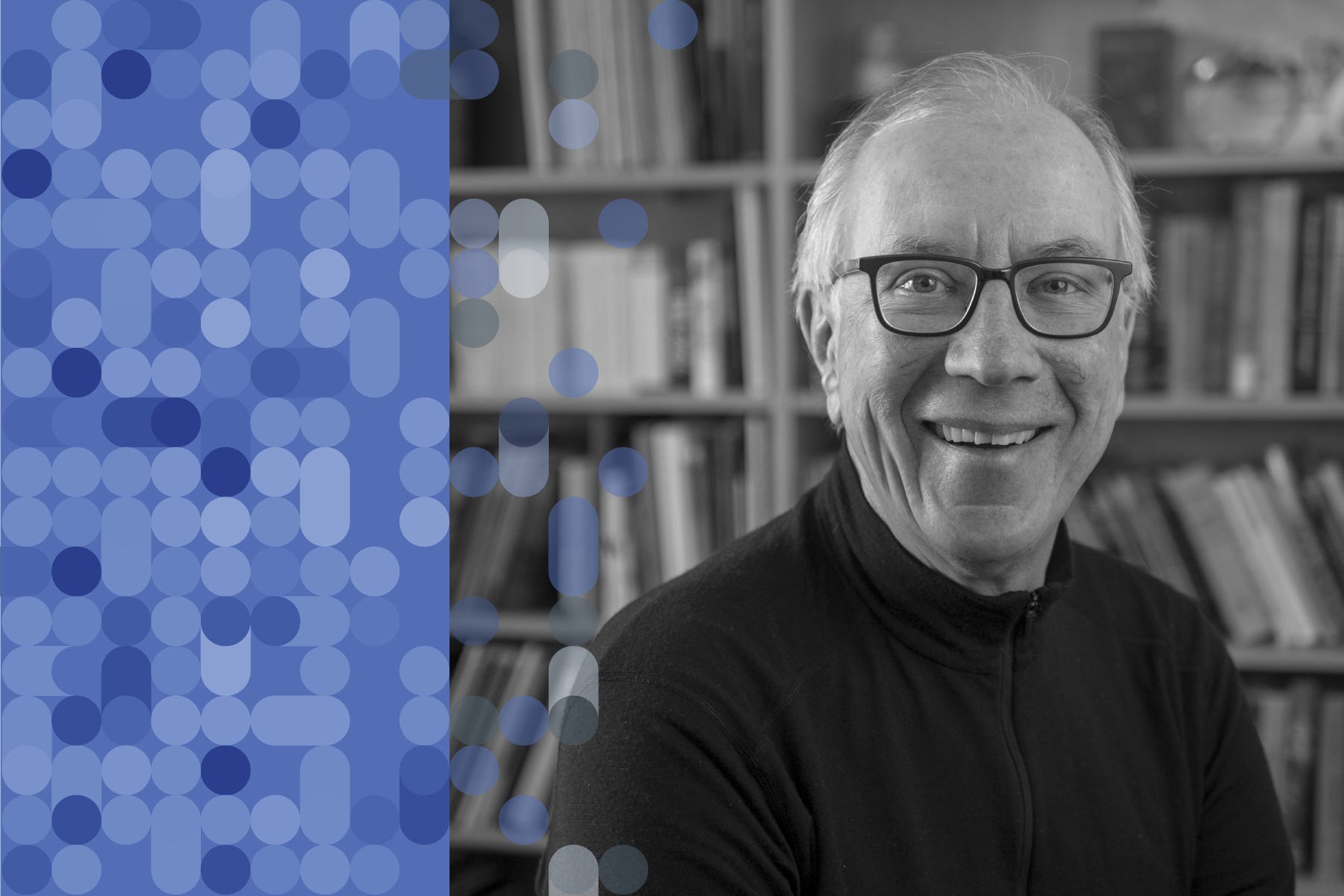
Tom Cech: RNA Takes Center Stage
In this podcast, Thomas Czech, Distinguished Professor at the University of Colorado, Boulder, with a lineage of remarkable contributions on RNA, ribozyme, and telomeres, discuss why RNA is so incredibly versatile.
Video snippet from our conversation. Full videos of all Ground Truths podcasts can be seen on YouTube here. The audios are also available on Apple and Spotify.
Transcript with links to the audio and external links
Eric Topol (00:07):
Well, hello, this is Eric Topol from Ground Truths, and it's really a delight for me to welcome Tom Cech who just wrote a book, the Catalyst, and who is a Nobel laureate for his work in RNA. And is at the University of Colorado Boulder as an extraordinary chemist and welcome Tom.
Tom Cech (00:32):
Eric, I'm really pleased to be here.
The RNA Guy
Eric Topol (00:35):
Well, I just thoroughly enjoyed your book, and I wanted to start out, if I could, with a quote, which gets us right off the story here, and let me just get to it here. You say, “the DNA guy would need to become an RNA guy. Though I didn’t realize it at the time, jumping ship would turn out to be the most momentous decision in my life.” Can you elaborate a bit on that?
Tom Cech (01:09):
As a graduate student at Berkeley, I was studying DNA and chromosomes. I thought that DNA was king and really somewhat belittled the people in the lab next door who were working on RNA, I thought it was real sort of second fiddle material. Of course, when RNA is acting just as a message, which is an important function, a critical function in all life on earth, but still, it's a function that's subservient to DNA. It's just copying the message that's already written in the playbook of DNA. But little did I know that the wonders of RNA were going to excite me and really the whole world in unimaginable ways.
Eric Topol (02:00):
Well, they sure have, and you've lit up the world well before you had your Nobel Prize in 1989 was Sid Altman with ribozyme. And I think one of the things that struck me, which are so compelling in the book as I think people might know, it's divided in two sections. The first is much more on the biology, and the second is much more on the applications and how it's changing the world. We'll get into it particularly in medicine, but the interesting differentiation from DNA, which is the one trick pony, as you said, all it does is store stuff. And then the incredible versatility of RNA as you discovered as a catalyst, that challenging dogma, that proteins are supposed to be the only enzymes. And here you found RNA was one, but also so much more with respect to genome editing and what we're going to get into here. So I thought what we might get into is the fact that you kind of went into the scum of the pond with this organism, which by the way, you make a great case for the importance of basic science towards the end of the book. But can you tell us about how you, and then of course, many others got into the Tetrahymena thermophila, which I don't know that much about that organism.
Tom Cech (03:34):
Yeah, it's related to Tetrahymena is related to paramecium, which is probably more commonly known because it's an even larger single celled animal. And therefore, in an inexpensive grade school microscope, kids can look through and see these ciliated protozoa swimming around on a glass slide. But I first learned about them when I was a postdoc at MIT and I would drive down to Joe Gall's lab at Yale University where Liz Blackburn was a postdoc at the time, and they were all studying Tetrahymena. It has the remarkable feature that it has 10,000 identical copies of a particular gene and for a higher organism, one that has its DNA in the nucleus and does its protein synthesis in the cytoplasm. Typically, each gene's present in two copies, one from mom, one from dad. And if you're a biochemist, which I am having lots of stuff is a real advantage. So 10,000 copies of a particular gene pumping out RNA copies all the time was a huge experimental advantage. And that's what I started working on when I started my own lab at Boulder.
Eric Topol (04:59):
Well, and that's where, I guess the title of the book, the Catalyst ultimately, that grew into your discovery, right?
Tom Cech (05:08):
Well, at one level, yes, but I also think that the catalyst in a more general conversational sense means just facilitating life in this case. So RNA does much more than just serve as a biocatalyst or a message, and we'll get into that with genome editing and with telomerase as well.
The Big Bang and 11 Nobel Prizes on RNA since 2000
Eric Topol (05:32):
Yes, and I should note that as you did early in the book, that there's been an 11 Nobel prize awardees since 2000 for RNA work. And in fact, we just had Venki who I know you know very well as our last podcast. And prior to that, Kati Karikó, Jennifer Doudna who worked in your lab, and the long list of people working RNA in the younger crowd like David Liu and Fyodor Urnov and just so many others, we need to have an RNA series because it's just exploding. And that one makes me take you back for a moment to 2007. And when I was reading the book, it came back to me about the Economist cover. You may recall almost exactly 17 years ago. It was called the
You May Also Like

Real Ghost Stories Online
Real Ghost Stories Online | Paranormal, Supernatural & Horror Radio

The 365 Days of Astronomy
365DaysOfAstronomy.org

Trent Loos Podcast
Trent Loos
The Biotech Startups Podcast
Excedr
Science Friday
Science Friday

Farm Small Farm Smart Daily
The Modern Grower Podcast Network

Science Vs
Spotify Studios
New Books in Public Policy
New Books Network
New Books in Education
Marshall Poe

KI verstehen
Deutschlandfunk
Real Ghost Stories Online
Real Ghost Stories Online | Paranormal, Supernatural & Horror Radio
The 365 Days of Astronomy
365DaysOfAstronomy.org
Trent Loos Podcast
Trent Loos
The Biotech Startups Podcast
Excedr
Science Friday
Science Friday
Farm Small Farm Smart Daily
The Modern Grower Podcast Network
Science Vs
Spotify Studios
New Books in Public Policy
New Books Network
New Books in Education
Marshall Poe
KI verstehen
Deutschlandfunk
Community discussion