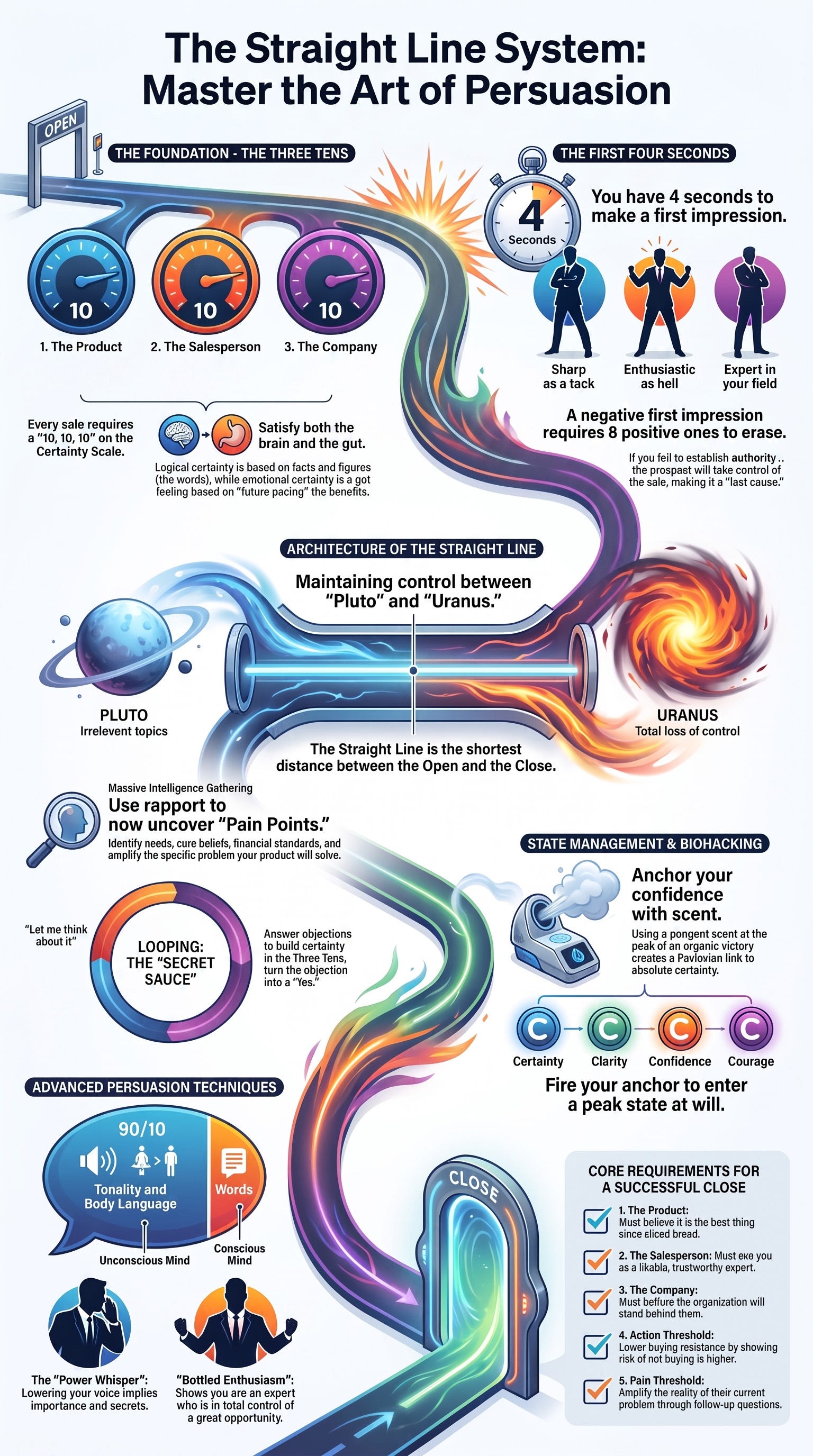
Jedi Mind Tricks of Unapologetically Effective Persuaders
The manifesto of the world's most infamous salesman, Jordan Belfort, has some devilishly clever persuasion hacks.
Let’s dive right in by looking at Jordan’s best state-management biohack...
The olfactory biohack for instant confidence
The key distinction here is that once you’ve learned the technique for triggering an empowered state (I’m going to teach you the most powerful one in the world in a moment), you only want to use it at certain key moments, when it matters most, like before you enter a sales encounter, or try to close a business deal, or enter into a negotiation, or even if it’s just an important decision you need to make in your personal life.
The most common state that salespeople will try to set an anchor for is a state of absolute certainty, and the most common anchor they’ll choose to try to link it to is a combination of shouting the word “yes” and simultaneously clapping their hands.
Anchoring confidence
The key, Bandler explained, is that you have to be at the absolute tippy-top of the state, in terms of the emotional intensity you feel inside, in order to successfully set an anchor. Anything less than that, and the anchor won’t set.
let’s choose a state of absolute certainty, as this is the state that you must be in when you enter any sales encounter.
Scent anchoring
It had to be a scent that was extreme enough, unusual enough, powerful enough, and pungent enough to meet Bandler’s criteria, yet still be pleasing enough to the nose to not gross me out or become its own negative anchor.
You wait for a very specific moment, and then take out your BoomBoom [scent anchor], unscrew the top, and follow the steps above—take a massive blast up each nostril and then ball your hands up into fists and dig your fingernails into your palms, and belt out the word “yes” in a powerful yet controlled manner. Then, ten seconds later, with the scent of BoomBoom still lingering but the initial rush gone, repeat the process again. And that, as they say, is that.
Jordan recommends this product, the BoomBoom, which apparently hits you with a really strong and distinctive energizing scent. But it doesn’t seem wise to anchor your confidence to a specific product, as they may go out of business. Also, it looks like BoomBoom is only available in America. I suggest anchoring with essential oils; the ones with the strongest scents are Patchouli, Frankincense, Eucalyptus, and Ylang Ylang. In the past, I’ve used a smelly old dry cigar as a scent anchor.
I’ve got an add-on mindset strategy to stack on top of the olfactory confidence biohack. Recently, I have been anchoring certainty and confidence while doing the Dispenza-style epigenetic mindset transformation meditation.
Update: The olfactory confidence Biohack made it into fiction, my novel, Hourglass. In the chapter, The Addict, I describe how the protagonist stacks it with three other confidence hacks...
Xavier had once dropped $1800 on a 3-day Neuro-Linguistic Programming workshop. He had picked up three surprisingly effective methods for instant confidence from the workshop…1) Scent TriggeringThis is classic Pavlovian conditioning; in a simple yet potent hack of olfactory memory, one anchors a scent to a desired mindset. Xavier’s was mistletoe - whenever he had emerged victorious from a windfall Sim poker game, elated by the win, he took a big whiff of mistletoe. Thereby associating the scent with a headspace of massive confidence. This was a two-way biological street, provided he didn’t dilute the scent by over a 1:3 proportion (one-time faking confidence, for every two times anchoring the smell to an actual event) - according to the sandal-wearing, long-haired, eccentric, and energetic NLP guru.2) Ape-ingThis biohack was less complex; one would act like an aggressive ape for about two minutes, shaking one’s arms above one’s head and reaching for imaginary branches. Done in private, of course, or with friends for riotous hilarity.3) 60 Seconds of Arbitrary LaughterXavier found that deep, belly laughter for one minute was a sure stimulator of peak confidence and mood. The first 20 seconds were always awkward and forced, but after that, laughing at laughing became self-evidently funny and carried him into a quintessentially playful state.
The Straight Line System
THE FIVE CORE ELEMENTS
1 The prospect must love your product.
2 The prospect must trust and connect with you.
3 The prospect must trust and connect with your company.
4 Lower the action threshold.
5 Raise the pain threshold.
The three tens
1 The prospect must love your product.
2 The prospect must trust and connect with you.
3 The prospect must trust and connect with your company.
Vs objections
In reality, though, the actual meaning of any particular objection has very little to do with what it states on the surface. You see, at the end of the day, objections are merely smoke screens for uncertainty for one or all of the Three Tens. In other words, if you ask for the order and your prospect is not high enough on the certainty scale, then they’ll throw out a smoke screen in the form of one of the common objections
Future pacing
We call this technique future pacing, and it serves as the very backbone of how we move someone emotionally. When you future pace someone, you’re essentially playing out the post-buying movie in the best fashion possible—allowing that person to experience your product’s amazing benefits right now, along with the positive feelings they create. The prospect’s needs have been filled; their pain has been resolved; any itch the they had has been scratched, and they are feeling wonderful as a result of it.
In short, future pacing entails running an imaginary movie through your mind where you get to see yourself in the future having already achieved a certain outcome. The result is that you get to experience the positive feelings associated with a future achievement right now
The First Four Seconds
During a phone call with a prospect, you have a bit longer—you have four seconds to make an impression. To be clear, though, even when you’re in person, it still takes four seconds before a final judgment gets made. The difference is that the process starts sooner when you’re in person—literally from the first moment the prospect lays eyes on you. But, either way, whether in person or over the phone, there are three things that you need to establish in those first four seconds of an encounter, if you want to be perceived in just the right way:1 Sharp as a tack2 Enthusiastic as hell 3 An expert in your fieldThose three things absolutely must come across in the first four seconds of a conversation; otherwise, you set yourself up for a major uphill battle. Now, in truth, if you screw up the first four seconds, you have another ten seconds, at most, to play catch-up ball, but after that, you’re completely done. It’s basically a lost cause. You can’t influence anybody.
Tonality and Body Language
You’ll be judged by your cover
The things a person will internally debate start with a very basic observation: your appearance. They’ll then
You May Also Like

Worship & Wonder Daily Devotional
Westminster Presbyterian Church

Scrolls & Secrets
Scrolls & Secrets

Renascença - Pergunte ao Pe. Paulo Franco
Renascença

Darrers podcast - Ràdio Cubelles
Ràdio Cubelles

Darrers podcast - Ràdio Ciutat de Badalona
Ràdio Ciutat de Badalona

CHURCH on SermonAudio
Various Speakers

Church Unity: The Forgotten Treasure
Paul J. Bucknell

Unter Büchern mit Katrin Schumacher
Mitteldeutscher Rundfunk

Podcast Paris United
Paris United

Deep Sessions & Toxic Journey Episodes
Dj zeb
Worship & Wonder Daily Devotional
Westminster Presbyterian Church
Scrolls & Secrets
Scrolls & Secrets
Renascença - Pergunte ao Pe. Paulo Franco
Renascença
Darrers podcast - Ràdio Cubelles
Ràdio Cubelles
Darrers podcast - Ràdio Ciutat de Badalona
Ràdio Ciutat de Badalona
CHURCH on SermonAudio
Various Speakers
Church Unity: The Forgotten Treasure
Paul J. Bucknell
Unter Büchern mit Katrin Schumacher
Mitteldeutscher Rundfunk
Podcast Paris United
Paris United
Deep Sessions & Toxic Journey Episodes
Dj zeb
Community discussion