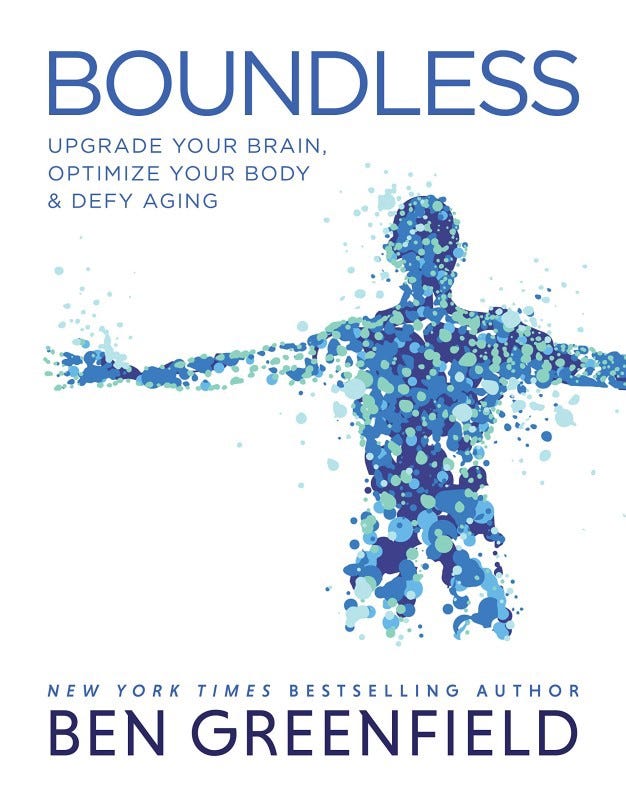
32 takeaways from the BIGGEST biohacking book
I write this with a sense of accomplishment, having just finished Ben Greenfield’s +1000-page magnum opus, Boundless. I’m something of a superfan of Ben’s - I read and listen to nearly everything he puts out - and I do recommend this book enthusiastically, but I’ll begin my review with some criticisms...
The book begins with a grandstanding introduction to Ben. He lets you know just how AWESOME he is - how amazingly athletic he is, how successful he’s been in business, how happy his family is, etc. Apparently, he finds time to read “a book every day” while maintaining the physique of a Greek god, being a CEO, and a devoted family man. The implication is “do what I’ve done, and you’ll be like me,” which is not totally misleading: the more you invest in your health, the better your life will get. Biohacking really does broaden your horizons; it’s the most surefire way to wield true free will, rise above mundanity, plot your own course, and take your destiny into your own hands.
But I read the introduction, not thinking Ben was wildly exaggerating, but that he has won the genetic lottery in a major way and then stacked on a bunch of hacks, resulting in his awesome life.If you’re red-pilled on genetics, you know that religion encourages evolutionary fitness; in general, more religious people are more evolutionarily fit. You would expect a tall, good-looking, fervently religious guy descended from American pioneer stock, like Ben, to have a good life because of the special evolutionary pressures put on his ancestors. People often compliment me on my intelligence and intellect, and that’s NOT something I take full credit for; my grandfather was one of the top NASA engineers responsible for getting men to the moon and back. I too have been gifted some by the genetic lottery - which I think Ben should have given some more credit to.
I have to deduct a star for the relentless pitching throughout the book, a criticism that many other reviewers make. Obviously, biohackers need to spend some money on products and supplements to optimize health, but product and brand recommendations are made so frequently that it’s clear that Ben Greenfield & Co did a lot of sponsorship sales pre-publication. There are a couple of issues with this other than the obvious one - a book should NOT be an advertising platform (especially a $55 one!)
* The book will not age well because health companies and brands go out of business, rebrand, discontinue products, and sometimes even sell out to multinational chemical corporations. Napoleon Hill’s iconic Think and Grow Rich would not be such a timeless book if it were urging readers to mail-order Cocaine Tooth Drops from the Sears Roebuck catalog!
* Some of the products are only available to the American market, and (NEWSFLASH) not everyone lives in America.
* It makes it seem like biohacking and healthy living are only for rich people who can afford to spend hundreds of dollars a month on supplements and thousands on fancy biohacking devices and tech. If you’re a biohacker ballin’ on a budget, check out my deep-dive podcast, 33 IMPACTFUL free (or cheap) biohacks & lifehacks.
But I won’t be as harsh as some of the book’s reviewers on this point because the book contains just as many free or cheap things that people can do to optimize their health. Each chapter has an exhaustive recommended resources page on the book’s website, and THAT is the place for affiliate and sponsor recommendations, not in the pages of a pricier book (even the Kindle ebook is $30) that is going to sit on people’s bookshelves for decades!
With those two criticisms out of the way, Boundless belongs on your bookshelf.
I’ve read a few podcasters’ books where basically what they did was copy and paste transcripts of interviews - they book-ified their podcasts - and it just doesn’t translate great; if I wanted interviews, I’d just go listen to the interviews. Stop doing this, podcasters! Thankfully, Ben didn’t do that with Boundless - it’s a real book that follows the compelling format that educational and edifying nonfiction should: Story, Theory, Data, and Pragmatic Takeaway.
How I hack my forgetting of book knowledge
If you’re going to spend hours and hours of your precious time reading nonfiction books for edification, you’re kind of wasting your time if you eventually forget 90% of what you read. The way I hack this is by highlighting passages and facts that I want to commit to memory and then, after finishing the book, adding those with hints to the SuperMemo app. Then it takes me just 15-30 minutes of memory practice a week to stay savvy with hundreds of pieces of semantic memory that I’ve picked up from books (even books I read years and years ago).
To take this to the next level, combine it with mnemonics practice. Using my own creativity and phonetic number pegging, I committed to memory a factoid from every chapter of Boundless. Read some books on Mnemonics because even average memories are remarkably powerful when used properly...
Nootropics vs Smart Drugs
There is a difference...
If a drug is strongly felt on a consistent basis whenever you use it and it makes you high, wired, or sedated, it is acting more like a smart drug or performance enhancer and is likely not a natural nootropic. Nootropics are sustainable for long-term use, while smart drugs are not. (p.127)
Many people use the terms nootropic and smart drug as if they mean the same thing, but they’re actually very distinct. All nootropics are technically smart drugs, but the opposite is not necessarily true. A smart drug is any substance that enhances memory, mood, concentration, or another aspect of cognitive function. Nootropics target the same functions, but by definition they must also be neuroprotective and nontoxic, and they are usually derived from natural, nonsynthetic sources. (p.146)
So Modafinil would be a quintessential example of a non-Nootropic smart drug.
I recorded this podcast/vlog on Zamner Joice and Brain Flow from Nootopia.
Weight training and minimum effective dose of exercise
Quite simply, strength training is one of the most effective anti-aging tools in the aspirational immortals’ toolbox - lift heavy stuff, and you’ll live longer.
A 2007 study demonstrated that six months of progressive resistance training, otherwise known as “lifting heavy stuff,” made the gene expression of aging mitochondria appear to be significantly younger. (p. 318)
The researchers reported: “Healthy older adults show a gene expression profile in skeletal muscle consistent with mitochondrial dysfunction and associated proces
You May Also Like

Worship & Wonder Daily Devotional
Westminster Presbyterian Church

Scrolls & Secrets
Scrolls & Secrets

Renascença - Pergunte ao Pe. Paulo Franco
Renascença

Darrers podcast - Ràdio Cubelles
Ràdio Cubelles

Darrers podcast - Ràdio Ciutat de Badalona
Ràdio Ciutat de Badalona

CHURCH on SermonAudio
Various Speakers

Church Unity: The Forgotten Treasure
Paul J. Bucknell

Unter Büchern mit Katrin Schumacher
Mitteldeutscher Rundfunk

Podcast Paris United
Paris United
Deep Sessions & Toxic Journey Episodes
Dj zeb
Worship & Wonder Daily Devotional
Westminster Presbyterian Church
Scrolls & Secrets
Scrolls & Secrets
Renascença - Pergunte ao Pe. Paulo Franco
Renascença
Darrers podcast - Ràdio Cubelles
Ràdio Cubelles
Darrers podcast - Ràdio Ciutat de Badalona
Ràdio Ciutat de Badalona
CHURCH on SermonAudio
Various Speakers
Church Unity: The Forgotten Treasure
Paul J. Bucknell
Unter Büchern mit Katrin Schumacher
Mitteldeutscher Rundfunk
Podcast Paris United
Paris United
Deep Sessions & Toxic Journey Episodes
Dj zeb
Community discussion