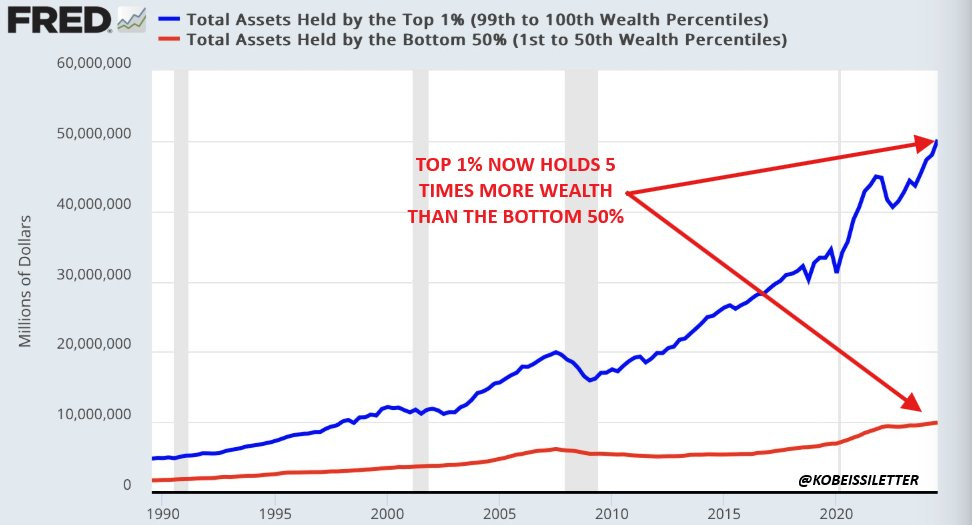
To investors, Things are about to get very crazy across financial markets. Now I know there are plenty of people predicting the next recession is right around the corner, but they are simply wrong. I am not sure if they are looking at bad data, drawing bad conclusions from good data, or some combination of the two. It doesn’t really matter how they are arriving at the wrong conclusion. They are just flat out wrong. Take the US stock market as one data point. Adam Kobeissi writes : “The stock market is incredibly hot. Since 1975, there have only be 6 times where the S&P 500 rose +30% or more in 5 months. 2025 is one of those times. In 100% of these cases, the S&P 500 has ended higher in the following 6 and 12 months, per Carson Research. In fact, during such occurrences, the S&P 500 has rallied by an average of +18.1% in the following 12 months.” Those are insane numbers. You want to bet against history? Be my guest. I like to think of financial markets similar to science though. Things in motion tend to stay in motion. Momentum is one powerful force. But this is where things get interesting. If the stock market is growing by 30% in 5 months, there has to be someone getting richer, right? Who is holding all those stocks? Adam goes on to explain : “Newly released data shows that US household net worth jumped by +$7.1 TRILLION in Q2 2025 alone. In other words, for 3-straight months, US households added an average of +$79 BILLION in net worth PER DAY…. As a result, the rich are getting much richer . Currently, the bottom 50% of US households now hold just 2.5% of total US wealth. In fact, the top 1% now holds $40 TRILLION more wealth than the bottom 50% combined.” So to recap this situation, the stock market just drove historic returns over the last 5 months. It made rich people ever richer, while the bottom 50% of Americans were left sitting on the sidelines. That isn’t the rich people’s fault. It is a financial education problem. In fact, I would argue we have a national crisis in this country until we figure out how to educate every student on personal finance and investing. Asset owners will be winners and savers will be losers moving forward. You may not like it, but it doesn’t make it untrue. This bull market is not close to over either. Mike Zaccardi write s “The average bull market lasts 70 months. We are about to complete month 35 of this one.” That is a narrative violation, right? I know your pessimist neighbor isn’t telling you this data. But data is data and almost all of it points to the fact that we are in a bull market that has plenty of legs left. This brings us to the Federal Reserve meeting this week, which should culminate in an interest rate cut. Yes, they are going to cut rates with the stock market at all time high and the government inflation data measuring above 2.5%. We have never seen a situation like this before. Creative Planning’s Charlie Bilello points out the last time the Fed cut interest rates with inflation over 2.9% was in October 2008, “in the midst of the worst recession/bear market since the Great Depression.” There are two big conclusions I have from this unprecedented move. First, the Fed is going to do this because of the labor market. Artificial intelligence has been a massive deflationary force in the US economy. Companies are figuring out how to be more productive and profitable with fewer employees. But second, the Federal Reserve has been behind the curve for months. I believe the Fed should make a 50-75 basis point cut in interest rates so they can catch up to where they should be, but history suggests the Fed will avoid being bold in their decision. Jordi Visser explained to me this weekend why he sees the odds of a 50 basis point cut increasing: But let’s level set for a second. Polymarket odds are only 8% for a 50 basis point cut, which is very low compared to the 90% odds of a 25 basis point cut this week. It ultimately is not going to matter whether the cut is 25, 50 or 75 basis points though. Carson Group’s Ryan Detrick writes “The Fed last cut in December of 2024, so it'll be nine months between cuts. Waiting 5-12 months between cuts tends to be bullish for the S&P 500. Higher a year later 10 out of 11 times with above average returns should have bulls smiling.” The Fed is going to push asset prices, from stocks to gold to bitcoin, to much higher levels. They can’t help themselves. They have to address the labor market issues or they will have a bigger problem on their hands. Put aside the fact that the government’s data misled the Fed into believing inflation was much higher than it actually was. Ignore the fact the Fed has become a politicized organization that seems to be cheering against the current administration’s economic plans. And refrain from getting worked up about the Fed’s flip-flopping about being “data dependent.” The central bank is now backed in a corner. They have to cut interest rates. Given asset prices are near all-time highs, we can onl