
Brazil Crypto Report
关于
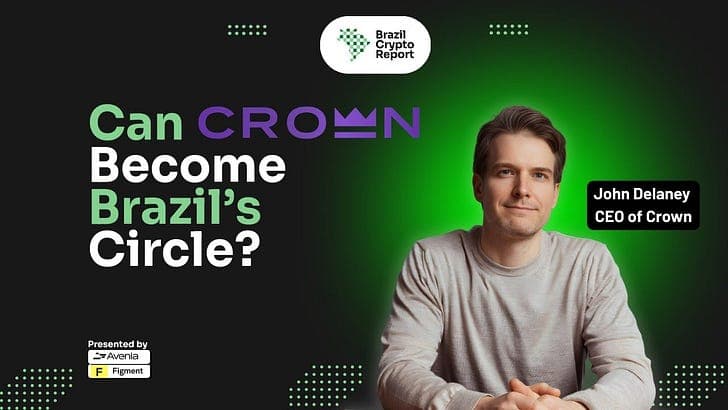
Episode 178: Can Crown Become the Circle of Brazil?
Dec 18, 2025·—
—
🙌 You can listen to BCR on your favorite podcast platform YouTube | Spotify | Apple Podcasts 🔥 Join the BCR English language Telegram group to continue the conversation Ola pessoal! Today’s episode is with John Delaney, co-founder and CEO of Crown - which has quickly become a major player in a Brazilian stablecoin market that is entering a new phase of maturity. John shares how Crown is solving what he identifies as the most acute problem in Brazil’s digital asset ecosystem: enabling institutional players to capture yield in a high interest rate environment. The Numbers Speak for Themselves Crown has achieved remarkable traction since launching BRLV, which is now the largest emerging market stablecoin with over 360 million BRL in circulation . The company recently closed a $13 million Series A round led by Paradigm. But what makes Crown’s approach distinctive isn’t just the capital raised or volumes achieved - it’s the architectural decisions that underpin the product. Why Brazil? Why Now? Delaney, a former Cleary Gottlieb lawyer who worked on structured finance deals including Nubank’s early credit card funding, brings deep expertise across American and Brazilian financial markets to the project. His thesis centers on three key attributes that make Brazil an ideal stablecoin market: * A trillion-dollar-plus M2 money supply * A crypto-friendly regulatory environment fostered by the Central Bank * Positive real interest rates that significantly outpace inflation The Yield Generation Advantage Unlike traditional stablecoin models where issuers retain all interest income generated by reserve assets, BRLV shares yield with institutional partners at what Delaney describes as “a very deep architectural level.” This design choice directly addresses the opportunity cost institutional players face when holding stablecoins in high-yield environments , a problem that doesn’t exist to the same degree in low-rate markets like the US or Europe. Security First Beyond yield generation, Crown has implemented what may be the most robust security structure in the stablecoin industry globally . BRLV features a bankruptcy-remote reserve holding combined with perfected legal guarantees, ensuring that token holders maintain claims on underlying assets even if Crown itself fails. This represents the first implementation of security protections outlined in frameworks like the Genius Act. An Ambitious Vision Delaney’s long-term target: one trillion BRL in circulation within ten years, representing high single-digit percentage of Brazil’s M2 money supply. He views the stablecoin market as winner-take-all, or at minimum winner-take-most, drawing parallels to the USDT/USDC duopoly. As Brazil’s stablecoin market enters a new phase of maturity, Crown’s rapid ascent offers important lessons for how institutional-grade infrastructure is being built in emerging markets. You can connect with John on Linkedin . Key Takeaways: ✓ Native yield architecture – BRLV enables institutional holders to capture yield from Brazil’s high interest rate environment ✓ Bankruptcy-remote structure – First global implementation of perfected legal guarantees protecting stablecoin holders ✓ Market opportunity – Brazil’s trillion-dollar M2 money supply and positive real rates create optimal conditions ✓ Institutional focus – Go-to-market strategy prioritizes institutional flows that drive majority of volumes ✓ Ambitious scaling – Target of one trillion BRL circulation within 10 years Have a great week everyone, -AWS Brazil Crypto Report is presented by Avenia is the programmable financial infrastructure for Latin America. Connect to local payment rails like PIX, SPEI and CBU — using stablecoins as settlement — and unlock real-time, cross-border payments without banks, FX desks, or SWIFT. Whether you’re building a wallet, a crypto card, or a global treasury solution, Avenia gives you the APIs and compliance-ready infrastructure to scale in LatAm. Move money between BRL, USD, MXN and more — fast, transparent, and fully on-chain. https://avenia.io/ Figment is the leading independent provider of staking infrastructure with $18B assets under stake and provides the complete solution for over 1000 institutional clients in Latin America and globally. Through its enterprise-grade infrastructure, Figment enables clients such as banks and exchanges, to earn rewards on Proof-of-Stake assets such as Ethereum and Solana, while maintaining the highest standards of security, compliance, and performance. Recent Episodes Get full access to Brazil Crypto Report at newsletter.brazilcrypto.io/subscribe
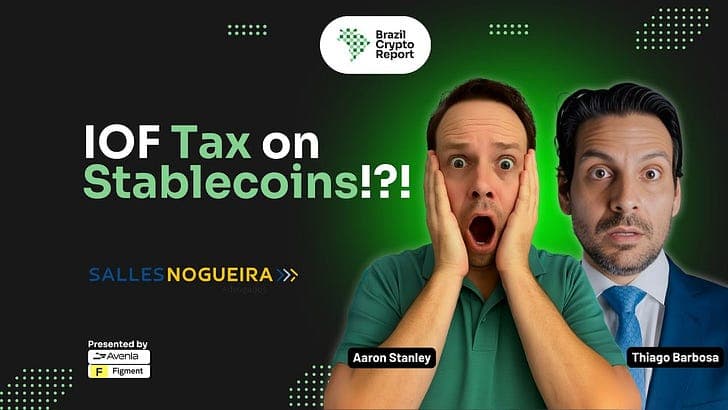
Episode #177: No Place To Hide: Brazil's New Crypto Tax Regime with Thiago Barbosa
Dec 14, 2025·—
—
🙌 You can listen to BCR on your favorite podcast platform YouTube | Spotify | Apple Podcasts 🔥 Join the BCR English language Telegram group to continue the conversation Ola pessoal! The era of taxation loopholes and gray areas appears to be rapidly coming to an end in Brazil. Thiago Barbosa , partner at Salles Nogueira Advogados and a crypto tax law expert, joins the show to discuss sweeping regulatory changes that will transform how Brazilian crypto holders must report and pay taxes on their digital assets. Brazil is undergoing a major compliance transformation on two fronts. First, the new DeCripto regime replaces the old Normative Instruction 1888 reporting requirements , aligning Brazil with the OECD’s Crypto Asset Reporting Framework (CARF). This isn’t just a bureaucratic update - it’s Brazil joining a global information-sharing network that enables tax authorities to exchange crypto holder data across borders . In other words, if you’re a Brazilian trading on a foreign exchange, that platform will be reporting your activity back to the Receita Federal. Perhaps the most contentious development is the Finance Ministry’s stance on applying IOF (tax on financial operations) to stablecoin transactions. Here’s the issue: IOF was created before stablecoins existed, and the current law only covers currency issued by governments - not digital representations of fiat issued by private companies like USDT or USDC. This creates a legal loophole that technically exempts stablecoins from IOF. However, the government is engaged in what Thiago calls “rhetoric warfare.” By publicly stating that IOF will apply to stablecoins, they’re using fear to discourage companies from adopting them, even though they lack the legal authority to collect the tax without Congressional action. When companies avoid stablecoins out of uncertainty, they stick to traditional fiat channels where the government collects more fees. It’s regulatory intimidation without legislative backing, and Thiago warns that the Receita may attempt to unilaterally collect IOF on stablecoin transactions anyway, forcing companies into costly legal battles to defend themselves. Key Takeaways: * Global reporting is here : Foreign exchanges must now report Brazilian user data to the Receita Federal under the OECD framework, creating an international surveillance net * Three reporting obligations : Exchanges in Brazil, foreign platforms serving Brazilian users, and individual crypto holders all face new disclosure requirements * VASP licensing gets serious : The Central Bank’s new requirements demand significant capital, compliance infrastructure, and regulatory approval to operate * IOF stablecoin limbo : The government claims IOF applies to stablecoins despite legal gaps, using fear tactics to discourage adoption while avoiding legislative process * Lifestyle monitoring intensifies : The Receita Federal is investing heavily in AI and surveillance tools to identify mismatches between reported income and actual spending patterns The Bigger Picture: Financial Surveillance Escalates Perhaps most concerning is what Thiago revealed toward the end of our conversation: this crypto crackdown is part of a much broader financial surveillance push by the Brazilian government . The IRS is pouring resources into tracking everything from Instagram posts showcasing luxury lifestyles to international travel patterns—all to identify taxpayers whose spending doesn’t match their declared income. As Thiago bluntly put it, the window for undeclared crypto wealth is closing fast . With international data sharing, AI-powered surveillance, and increasingly sophisticated enforcement mechanisms, the “degens” who thought they could stay one step ahead of the Receita Federal are running out of room to maneuver. The message is clear: Brazil is serious about bringing crypto into the regulated fold, and non-compliance is becoming an increasingly risky bet . You can connect with Thiago on Linkedin and Instagram Have a great week everyone, -AWS Brazil Crypto Report is presented by Avenia is the programmable financial infrastructure for Latin America. Connect to local payment rails like PIX, SPEI and CBU — using stablecoins as settlement — and unlock real-time, cross-border payments without banks, FX desks, or SWIFT. Whether you’re building a wallet, a crypto card, or a global treasury solution, Avenia gives you the APIs and compliance-ready infrastructure to scale in LatAm. Move money between BRL, USD, MXN and more — fast, transparent, and fully on-chain. https://avenia.io/ Figment is the leading independent provider of staking infrastructure with $18B assets under stake and provides the complete solution for over 1000 institutional clients in Latin America and globally. Through its enterprise-grade infrastructure, Figment enables clients such as banks and exchanges, to earn rewards on Proof-of-Stake assets such as Ethereum and Solana, while maintaining the highest standards of security, comp

Episode #176: What's ACTUALLY Driving Stablecoin Adoption in Latam with Justin Norman
Dec 1, 2025·—
—
🙌 You can listen to BCR on your favorite podcast platform YouTube | Spotify | Apple Podcasts 🔥 Join the BCR English language Telegram group to continue the conversation Ola pessoal! Today’s episode is with Justin Norman, founder of The Flip , to discuss his recent on-the-ground research into stablecoin adoption across Latin America. Justin has spent years documenting technology adoption in emerging markets, and his latest YouTube documentary series provides rare, unfiltered insights into how stablecoins are actually being used in the region. The Argentina Paradox Justin’s investigation in Argentina revealed a fascinating disconnect. Despite $90 billion in stablecoin transaction volumes, visible retail adoption remains minimal. You won’t find prices listed in USDT or widespread merchant acceptance. So where are these volumes coming from? The answer lies in understanding stablecoins’ true utility in Argentina’s distorted economy. They primarily serve as store-of-value instruments and facilitate cross-border trade, rather than functioning as everyday payment methods. This reflects the reality of Argentina’s parallel exchange markets and chronic dollar shortages - conditions that create natural demand for dollar-denominated digital assets. Be sure to catch Justin’s brilliant documentary exploring stablecoins in Argentina below👇 Beyond the Hype Justin’s work cuts through the prevailing narratives around stablecoin adoption. While North American and European institutions focus on shaving basis points and improving settlement times, emerging markets face fundamentally different problems: currency devaluation, capital controls, and inadequate access to global financial infrastructure. The adoption pattern Justin documented isn’t limited to Argentina. He found striking similarities between Latin American markets like Bolivia and African markets like Nigeria —countries facing comparable macro pressures including fuel subsidy issues, dollar shortages, and import-dependent economies. Infrastructure Matters One key differentiator Justin identified: Latin America’s relatively robust payment infrastructure creates better conditions for stablecoin on-ramps and off-ramps compared to many African markets . The ability to scan a QR code and instantly convert stablecoins to local currency requires strong local payment rails—infrastructure that exists in varying degrees across emerging markets. Key Takeaways: * Real use cases differ from expectations : Stablecoins in Latin America primarily serve store-of-value and cross-border trade functions, not retail payments * Context is everything : Understanding macro conditions (dollar shortages, parallel markets, currency controls) is essential to understanding adoption patterns * Infrastructure enables adoption : Strong local payment systems make stablecoin conversion seamless, creating better user experiences * Emerging markets share common drivers : Similar economic pressures across Latin America and Africa create comparable crypto adoption patterns, though at different stages Justin’s documentary series represents essential viewing for anyone seeking to understand genuine stablecoin adoption beyond the hype cycle. You can connect with Justin on Linkedin . Have a great week everyone, -AWS Brazil Crypto Report is presented by Avenia is the programmable financial infrastructure for Latin America. Connect to local payment rails like PIX, SPEI and CBU — using stablecoins as settlement — and unlock real-time, cross-border payments without banks, FX desks, or SWIFT. Whether you’re building a wallet, a crypto card, or a global treasury solution, Avenia gives you the APIs and compliance-ready infrastructure to scale in LatAm. Move money between BRL, USD, MXN and more — fast, transparent, and fully on-chain. https://avenia.io/ Figment is the leading independent provider of staking infrastructure with $18B assets under stake and provides the complete solution for over 1000 institutional clients in Latin America and globally. Through its enterprise-grade infrastructure, Figment enables clients such as banks and exchanges, to earn rewards on Proof-of-Stake assets such as Ethereum and Solana, while maintaining the highest standards of security, compliance, and performance. Recent Episodes Get full access to Brazil Crypto Report at newsletter.brazilcrypto.io/subscribe

Episode #175: Inside BRL1 - Brazil's Liquidity Layer with Thomaz Teixeira and Ben Reid
Nov 19, 2025·—
—
🙌 You can listen to BCR on your favorite podcast platform YouTube | Spotify | Apple Podcasts 🔥 Join the BCR English language Telegram group to continue the conversation Olá pessoal! For today’s episode I’m joined by Thomaz Teixeira, CEO of BRL1, and Ben Reid, Head of Stablecoins at Bitso, to discuss the BRL1 stablecoin project. BRL1 represents a departure from the typical competitive dynamics we see in crypto markets. Instead of each exchange launching its own stablecoin, major Brazilian platforms Mercado Bitcoin, Bitso, Foxbit, and Cainvest formed a consortium to build shared infrastructure. Despite launching just months ago, BRL1 has already achieved impressive market penetration, r egularly trading as the sixth or seventh highest-volume crypto asset on Brazilian exchanges, ahead of established tokens like Dogecoin and sometimes even Solana. More significantly, BRL1 is capturing roughly half the trading volume of USDC in Brazil on centralized exchanges , a remarkable feat considering every user already had access to dollar-denominated stablecoins. What makes BRL1 particularly compelling is its focus on institutional use cases. The project is attracting significant interest from market makers and liquidity providers who need efficient rails for moving value between exchanges globally. As Teixeira explained, his background in high-frequency trading and algorithmic arbitrage positioned him to understand the friction points in cross-exchange liquidity flows, problems that BRL1 was specifically designed to address. Reid provided valuable context on the broader stablecoin landscape in Latin America, noting that institutional market makers are increasingly positioning themselves across G20 markets and seeking to onboard trusted local currency stablecoins. This isn’t speculative positioning - these players are responding to real demand from corporates conducting cross-border payments and financial institutions seeking more efficient settlement mechanisms. We also also touch on how BRL1 addresses some of the interoperability challenges that Brazil’s now-shuttered Drex CBDC project aimed to solve. By creating standardized infrastructure that connects previously siloed liquidity pools, BRL1 is demonstrating how private sector innovation can fill gaps in market infrastructure. Key Takeaways: * Consortium Model Shows Promise : Competitors collaborating on shared infrastructure can create network effects that benefit all participants and accelerate adoption * Institutional Traction Is Real : Market makers and liquidity providers are actively onboarding BRL1 for cross-exchange arbitrage and cross-border payment flows * Volume Metrics Validate Demand : BRL1’s trading volume already represents 50% of USDC’s Brazilian exchange volume despite being live for only months * Local Stablecoins Fill Market Gaps : Non-dollar stablecoins serve distinct use cases beyond currency speculation, particularly for regional market efficiency and capital flows You can connect with Thomaz and Ben on Linkedin. Have a great week everyone, -AWS Brazil Crypto Report is presented by Avenia is the programmable financial infrastructure for Latin America. Connect to local payment rails like PIX, SPEI and CBU — using stablecoins as settlement — and unlock real-time, cross-border payments without banks, FX desks, or SWIFT. Whether you’re building a wallet, a crypto card, or a global treasury solution, Avenia gives you the APIs and compliance-ready infrastructure to scale in LatAm. Move money between BRL, USD, MXN and more — fast, transparent, and fully on-chain. https://avenia.io/ Figment is the leading independent provider of staking infrastructure with $18B assets under stake and provides the complete solution for over 1000 institutional clients in Latin America and globally. Through its enterprise-grade infrastructure, Figment enables clients such as banks and exchanges, to earn rewards on Proof-of-Stake assets such as Ethereum and Solana, while maintaining the highest standards of security, compliance, and performance. Recent Episodes Get full access to Brazil Crypto Report at newsletter.brazilcrypto.io/subscribe
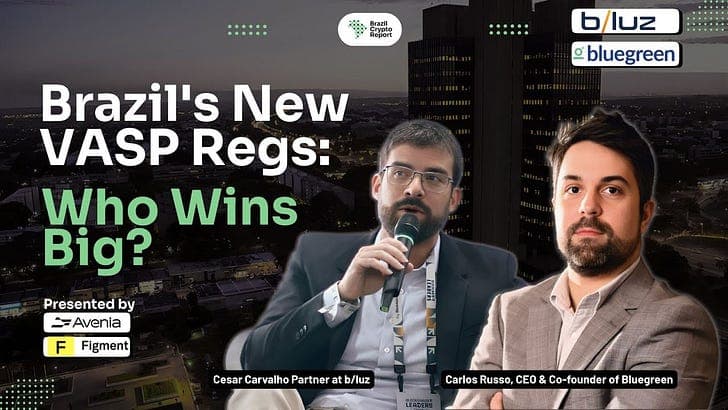
Episode #174: Winners and Losers of Brazil’s New VASP Rules with Carlos Russo and Cesar Carvalho
Nov 15, 2025·—
—
🙌 You can listen to BCR on your favorite podcast platform YouTube | Spotify | Apple Podcasts 🔥 Join the BCR English language Telegram group to continue the conversation Olá pessoal! You surely saw that Brazil’s Central Bank r eleased much-anticipated VASP regulations earlier this week. These rules have been in the works for three years now, and they bring significant clarity to the market and serve to (in some ways) level the playing field. To discuss what’s in these regulations, timelines and likely winners and losers, I’m joined by Carlos Eduardo Russo, CEO and co-founder of Bluegreen , and Cesar Carvalho, partner at Baptista Luz Advogados. Both Carlos and Cesar serve on the government relations team of the ABToken trade association and have been heavily involved in the rulemaking process. The VASP regulatory package comprises three primary resolutions addressing authorization requirements, operational compliance standards, and the integration of crypto assets into Brazil’s foreign exchange market. The framework represents the Central Bank’s attempt to balance market innovation with financial stability, though several contentious issues remain under discussion. Key Themes and Takeaways Authorization Timeline and Process * Regulations take effect February 2, 2025, with VASPs required to file formal authorization requests within nine months * A phased two-stage approval process is expected to span approximately three years from initial filing to final authorization * Companies must demonstrate operational readiness immediately upon filing, including compliance with cybersecurity, risk management, and AML obligations Capital Requirements Create Market Pressures * Minimum regulatory capital ranges from R$11.2 million to R$37.2 million depending on the business model * Industry advocates are pushing for a phased contribution calendar allowing companies up to two years to meet capital requirements * Smaller players face significant barriers to entry , potentially consolidating market share among established entities Level Playing Field—With Asterisks * All VASPs—domestic and international—must now report customer transactions to tax authorities with no loopholes * The framework addresses longstanding complaints from local exchanges about uneven compliance standards * However, concerns persist about regulatory advantages favoring traditional financial institutions (”TradFi”) over new VASP entrants Foreign Exchange Market Integration * Stablecoin transactions are now formally incorporated into Brazil’s regulated FX market * VASPs face stringent reporting requirements aligned with traditional FX brokers * This legitimizes crypto-based cross-border payments within Brazil’s regulatory framework The regulations represent a conservative, iterative approach from the central bank, which has signaled openness to continued industry dialogue. For stakeholders, the coming months will be critical as firms assess their compliance pathways and the industry advocates for refinements to ensure genuine competitive parity across all market participants. You can connect with Carlos and Cesar on Linkedin. Have a great week everyone, -AWS Brazil Crypto Report is presented by Avenia is the programmable financial infrastructure for Latin America. Connect to local payment rails like PIX, SPEI and CBU — using stablecoins as settlement — and unlock real-time, cross-border payments without banks, FX desks, or SWIFT. Whether you’re building a wallet, a crypto card, or a global treasury solution, Avenia gives you the APIs and compliance-ready infrastructure to scale in LatAm. Move money between BRL, USD, MXN and more — fast, transparent, and fully on-chain. https://avenia.io/ Figment is the leading independent provider of staking infrastructure with $18B assets under stake and provides the complete solution for over 1000 institutional clients in Latin America and globally. Through its enterprise-grade infrastructure, Figment enables clients such as banks and exchanges, to earn rewards on Proof-of-Stake assets such as Ethereum and Solana, while maintaining the highest standards of security, compliance, and performance. Recent Episodes Get full access to Brazil Crypto Report at newsletter.brazilcrypto.io/subscribe
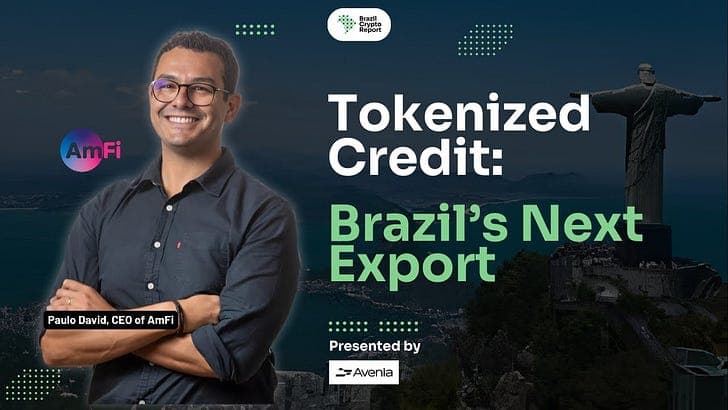
Episode #173: Brazil's Next Export: Tokenized Credit with Paulo David
Nov 11, 2025·—
—
🙌 You can listen to BCR on your favorite podcast platform YouTube | Spotify | Apple Podcasts 🔥 Join the BCR English language Telegram group to continue the conversation Olá pessoal! Today’s episode is with Paulo David, CEO and co-founder of AmFi, one of Brazil’s leading real-world asset tokenization platforms. Paulo is a serial entrepreneur who previously built and sold two major Brazilian fintechs - including Grafeno, which has processed over US$18 billion in transactions. He brings invaluable insights into how blockchain technology can transform the country’s capital markets. The Opportunity: Brazil’s “Most Attractive Export” Paulo frames Brazil’s challenge succinctly: t he country maintains the world’s second-highest interest rates, yet global investors remain largely absent from its private credit markets. While foreign capital flows freely into Brazilian equities, commodities, and venture investments, the private credit sector remains inaccessible due to complexity, lack of transparency, excessive intermediaries, and the absence of secondary markets. AmFi aims to bridge this gap by creating a standardized, transparent platform that connects Brazilian yield with global capital. Market Scale and Growth Trajectory The numbers tell a compelling story. Brazil’s capital markets have exploded from $20 billion to $150 billion in recent years, growing at approximately 40% annually with projections to reach $500 billion in the coming years. Yet a stark disparity remains: Brazil’s economy is 13 times smaller than the United States, but its private credit market is 56 times smaller. In Brazil, roughly 80% of business financing flows through traditional banks, while in the US, capital markets dominate - a dynamic Paulo sees shifting rapidly. Infrastructure Solutions Through Technology Drawing from his experience at Grafeno, where his solutions touched nearly 40% of all capital market assets in Brazil, Paulo identified critical infrastructure gaps that blockchain uniquely addresses. Unlike developed markets where technology provides incremental improvements, in Brazil it solves fundamental structural problems around transparency, automation, and market access. Expansion and Economic Impact AmFi’s near-term strategy focuses on consolidating its Brazilian presence while targeting distribution partnerships in Southeast Asia and the Middle East - regions with advanced digital asset adoption and appetite for emerging market yield. Paulo emphasized that increased foreign participation will drive competition, reduce spreads, and ultimately lower borrowing costs for Brazilian businesses, creating positive ripple effects throughout the economy. Key Takeaways: * Market opportunity : Brazilian private credit markets growing 40% annually toward $500B+ * Infrastructure gap : Blockchain solves transparency, accessibility, and secondary market challenges * Economic impact : Foreign capital influx will increase competition and reduce borrowing costs * Regulatory tailwinds : Brazil’s Central Bank actively supporting tokenization initiatives * Global expansion : Southeast Asia and Middle East prioritized for investor distribution You can connect with Paulo on Linkedin . Have a great week everyone, -AWS Brazil Crypto Report is presented by Avenia is the programmable financial infrastructure for Latin America. Connect to local payment rails like PIX, SPEI and CBU — using stablecoins as settlement — and unlock real-time, cross-border payments without banks, FX desks, or SWIFT. Whether you’re building a wallet, a crypto card, or a global treasury solution, Avenia gives you the APIs and compliance-ready infrastructure to scale in LatAm. Move money between BRL, USD, MXN and more — fast, transparent, and fully on-chain. https://avenia.io/ Figment is the leading independent provider of staking infrastructure with $18B assets under stake and provides the complete solution for over 1000 institutional clients in Latin America and globally. Through its enterprise-grade infrastructure, Figment enables clients such as banks and exchanges, to earn rewards on Proof-of-Stake assets such as Ethereum and Solana, while maintaining the highest standards of security, compliance, and performance. Figment supports the growth of the global blockchain ecosystem by making staking simple, transparent, and scalable. Figment is at the forefront of this transformation, providing the trusted infrastructure, insights, and expertise needed to enable clients to stake confidently. Recent Episodes Get full access to Brazil Crypto Report at newsletter.brazilcrypto.io/subscribe

Episode #172: Brazil's Oranje Pill with Gui Gomes
Oct 29, 2025·—
—
🙌 You can listen to BCR on your favorite podcast platform YouTube | Spotify | Apple Podcasts 🔥 Join the BCR English language Telegram group to continue the conversation Olá pessoal! For today’s episode I talk to Gui Gomes, CEO and founder of OranjeBTC, which became Latin America’s largest bitcoin treasury company and the 26th largest in the world when it publicly listed on Brazil’s B3 exchange earlier this month. We discuss how Oranje aims to be more than just a vehicle for acquiring bitcoin. Rather, Gui sees Oranje as a bitcoin-native company that will catalyze mass adoption of bitcoin across Latin America. Key Takeaways: * From Bridgewater to Bitcoin : Prior to joining Swan Bitcoin in 2022, Gomes spent several years at Ray Dalio’s Bridgewater Associates , where exposure to Dalio’s “Changing World Order” research helped crystallize his conviction that bitcoin represents the future of reserve currencies. The parallels between Dalio’s thesis on currency cycles and bitcoin’s value proposition were impossible to ignore. * Purpose-Built, Not Dabbling : Unlike other companies simply adding bitcoin to their balance sheets as a hedge, OranjeBTC is built from the ground up to operate on the bitcoin standard. Every aspect — from capital structure to hiring to cost basis — is designed around bitcoin accumulation and education. * Latin America’s Unique Opportunity : The region’s history with currency devaluation and inflation makes bitcoin particularly compelling solution. As Gomes puts it: “If bitcoin is good for Americans, bitcoin is great for Latin Americans.” With nearly a billion people and abundant natural resources held back by monetary instability, moving to a bitcoin standard could be transformational for the region. * US vs Brazil Adoption Gap : While US institutional understanding of bitcoin is more advanced, Brazil leads in regulatory clarity. Brazilian banks have been selling bitcoin directly from checking accounts since before US ETF approval—a capability American banks still don’t have. * Aggressive Growth Plans : Orange holds approximately 3,700 BTC and continues buying weekly. The company plans to deploy multiple capital instruments — equity offerings, convertible notes, and other tools — to accelerate treasury growth while creating value for shareholders. * Education as Mission : OranjeBTC is releasing comprehensive research papers on treasury companies, bitcoin fundamentals, and Latin American economic opportunities. It will be hosting institutional events and building educational content for both newcomers and sophisticated investors. Gomes brings a unique perspective shaped by traditional finance experience and hardcore bitcoin conviction. His vision extends beyond corporate treasury strategy to national-level adoption, believing Brazil’s 215 million people could set a transformative example for emerging markets worldwide. Gui also weighs in on the “debasement trade,” why digital natives will accelerate adoption, and how nation-states are just beginning to recognize bitcoin’s strategic importance. You can connect with Gui on Linkedin . Have a great week everyone, -AWS Brazil Crypto Report is presented by Avenia is the programmable financial infrastructure for Latin America. Connect to local payment rails like PIX, SPEI and CBU — using stablecoins as settlement — and unlock real-time, cross-border payments without banks, FX desks, or SWIFT. Whether you’re building a wallet, a crypto card, or a global treasury solution, Avenia gives you the APIs and compliance-ready infrastructure to scale in LatAm. Move money between BRL, USD, MXN and more — fast, transparent, and fully on-chain. https://avenia.io/ Recent Episodes Get full access to Brazil Crypto Report at newsletter.brazilcrypto.io/subscribe
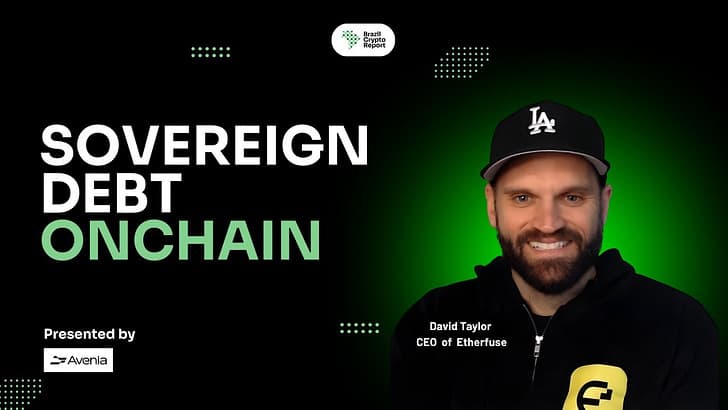
Episode #171: Can Stablebonds Bring Brazil On-Chain? with David Taylor of Etherfuse
Oct 22, 2025·—
—
🙌 You can listen to BCR on your favorite podcast platform YouTube | Spotify | Apple Podcasts 🔥 Join the BCR English language Telegram group to continue the conversation Olá pessoal! Today’s episode is with David Taylor, CEO and co-founder of Etherfuse, where we explore what might be the most overlooked infrastructure gap in crypto: tokenized sovereign debt. Taylor’s thesis is compelling: while crypto has created an explosion of speculative assets, it lacks the foundational building block that underpins all traditional finance: the risk-free rate. In TradFi, everything is measured against government bonds. But onchain? That benchmark simply doesn’t exist, creating a critical missing link between the blockchain and traditional finance worlds. His mission is to bring nations “onchain” by tokenizing their sovereign debt, starting with Mexico and now expanding into Brazilian Tesouro bonds. Key Takeaways: * Infrastructure for onchain sovereign debt : Etherfuse positions itself as the AWS-like infrastructure layer for tokenized government bonds , handling regulatory compliance, security, and collateralization so builders can simply integrate and create financial products without recreating this complex foundation * The non-USD opportunity : While most attention focuses on dollar-denominated assets, emerging markets like Brazil, Mexico, and Argentina offer clearer regulatory pathways and stronger incentives for innovation with local currency stablebonds * Solving the liquidity problem : By combining yield-bearing sovereign debt with blockchain rails, stablebonds create natural incentives for liquidity in non-USD stablecoins - something the market has desperately needed * Democratizing access to sovereign yields : By tokenizing government bonds as interest-bearing stablecoins, Etherfuse removes the traditional barriers that limited sovereign debt access to institutions and high-net-worth investors, allowing anyone with a crypto wallet to earn these yields * Historical precedent matters : Taylor points out that successful economies historically started with bonds (Venice, Amsterdam, France), not just currency. Crypto needs to follow the same playbook I really enjoyed this conversation with David and I hope you do as well. You can connect with him on Linkedin . Have a great week everyone, -AWS Brazil Crypto Report is presented by Avenia is the programmable financial infrastructure for Latin America. Connect to local payment rails like PIX, SPEI and CBU — using stablecoins as settlement — and unlock real-time, cross-border payments without banks, FX desks, or SWIFT. Whether you’re building a wallet, a crypto card, or a global treasury solution, Avenia gives you the APIs and compliance-ready infrastructure to scale in LatAm. Move money between BRL, USD, MXN and more — fast, transparent, and fully on-chain. https://avenia.io/ Recent Episodes Get full access to Brazil Crypto Report at newsletter.brazilcrypto.io/subscribe

Episode #170: Tokenizing Brazil: Onigiri Capital's $50 Million Bet
Oct 17, 2025·—
—
🙌 You can listen to BCR on your favorite podcast platform YouTube | Spotify | Apple Podcasts 🔥 Join the BCR English language Telegram group to continue the conversation Olá pessoal! Today we’re talking to Qin En Looi, Managing Partner at Onigiri Capital and Partner at Saison Capital, about why his Singapore-based venture fund is making a major bet on Brazil’s tokenization and stablecoin ecosystem. Backed by Credit Saison, a 75-year-old Japanese financial institution with US$30 billion in assets, Onigiri Capital recently launched a US$50 million fund focused exclusively on blockchain-powered financial services. Latin America — and specifically Brazil — will be key areas of focus for deploying this capital. What makes Brazil particularly attractive? According to Qin en, it starts with the Central Bank. “I don’t think any government or central bank in the world comes close to what the Brazilian Central Bank has done in terms of innovation,” he explains, pointing to initiatives like Drex and the country’s track record with PIX and open finance. But the regulatory environment is just one piece of the puzzle. Qin en notes that he has been impressed by how Brazilian blockchain founders are delivering metrics at Series A that rival Series C companies in other markets—often with profitability already achieved. “For the same valuation, I can get a company making two to three million dollars ARR, whereas elsewhere you’d have an unpaid pilot,” he notes. Key Takeaways: * Focused verticals: Onigiri is focusing primarily on stablecoins, payments, tokenized assets, financial markets infrastructure, and DeFi * Local-first approach: The firm is partnering with local funds like Norte Ventures, OneVC, and Valor Capital to better connect with the ecosystem * Institutional advantage: Portfolio companies gain access to Credit Saison’s extensive network of banks and asset managers across Asia * Capital efficiency: Brazilian startups demonstrate stronger revenue focus and resilience compared to peers in developed markets I really enjoyed this conversation with Qin en and I hope you do as well. It will be exciting to see how his thesis plays out in the coming years. You can connect with Qin en on Linkedin . Have a great week everyone, -AWS Brazil Crypto Report is presented by Avenia is the programmable financial infrastructure for Latin America. Connect to local payment rails like PIX, SPEI and CBU — using stablecoins as settlement — and unlock real-time, cross-border payments without banks, FX desks, or SWIFT. Whether you’re building a wallet, a crypto card, or a global treasury solution, Avenia gives you the APIs and compliance-ready infrastructure to scale in LatAm. Move money between BRL, USD, MXN and more — fast, transparent, and fully on-chain. https://avenia.io/ Recent Episodes Get full access to Brazil Crypto Report at newsletter.brazilcrypto.io/subscribe
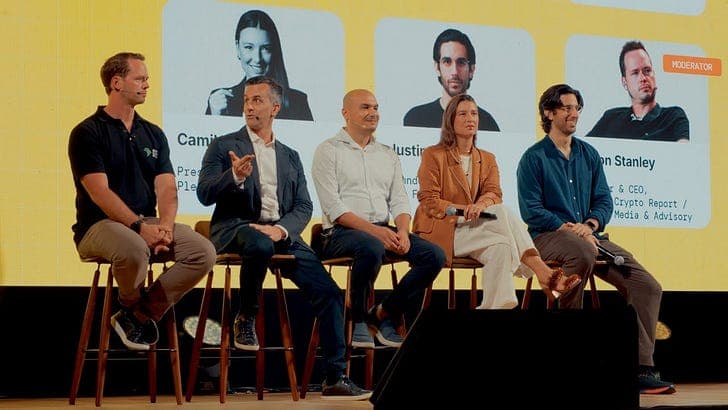
Episode #169: Live from Stellar Meridian 2025: Stablecoins for Local Solutions and Global Impact
Oct 2, 2025·—
—
🙌 You can listen to BCR on your favorite podcast platform YouTube | Spotify | Apple Podcasts 🔥 Join the BCR English language Telegram group to continue the conversation Olá pessoal! Last month at Stellar Meridian in Rio de Janeiro, I had the privilege of moderating a super interesting panel exploring how stablecoins are solving real problems in emerging markets. Joining me were: * Sebastian Siseles , CEO of Vesseo * Ibrahim Abdulhussein , CEO of Digibank * Camila Rioja, Executive Director of Plexus Institute * Justin Norman , founder of The Flip The conversation revealed that successful crypto adoption isn’t just about the technology - it’s about successfully pairing the technology with local operators and users to create the ideal localized solution. Ibrahim’s story exemplifies this perfectly. After struggling to send money to his father in war-torn Syria, he built Digibank - a network of 2,000+ physical cash-out points across the MENA region serving 31,000 users. The innovation? Users receive a PIN code via SMS or print, walk to a local merchant, and collect cash. No wallet required. No blockchain knowledge needed. Just simple access to remittances in countries where Western Union doesn’t operate. Sebastian shared how Vesseo is building a non-custodial wallet that prioritizes real-world usability over crypto education . Their mission: “earn global, spend local.” In the coming weeks, they’ll be launching the first Stellar wallet with crypto-to-fiat cards, allowing users to convert USDC at point-of-sale. As Sebastian put it, comparing a traditional $35 wire transfer to near-instant, near-free Stellar transactions is “no brainer” territory. Camila’s work with Plexus Institute showcases how existing systems can be enhanced with blockchain. Brazil already has 180+ community currencies serving municipalities across a country 205 times the size of Switzerland. Their Aratu project is piloting transparent, on-chain distribution of social benefits to communities of mainly women harvesting crabs in Brazil’s northeast. Justin, fresh from a three-week documentary tour across South America, emphasized what ties these stories together: last-mile user experience matters more than infrastructure hype . The excitement around stablecoins often focuses on volumes and new layer-ones, but real adoption happens when solutions are deeply localized for each context. Key Takeaways: * Context matters more than infrastructure - Each market has unique drivers: Bolivia’s dollar shortages, Argentina’s capital controls, Syria’s lack of banking infrastructure, Brazil’s community currency networks. * Abstract away the complexity - The best projects hide blockchain entirely. Users don’t need crypto knowledge to benefit from crypto rails. * Trust takes time - Digibank’s Syrian health workers initially cashed out salaries immediately; seven months later, many now hold USDC voluntarily. * Build on what exists - Don’t create new behaviors from scratch. Enhance existing financial practices with blockchain’s benefits. The future of stablecoins isn’t purely on-chain or off-chain. Rather, it’s intertwined with existing financial behaviors and meeting users where they are. Have a great week everyone, -AWS Brazil Crypto Report is presented by Avenia is the programmable financial infrastructure for Latin America. Connect to local payment rails like PIX, SPEI and CBU — using stablecoins as settlement — and unlock real-time, cross-border payments without banks, FX desks, or SWIFT. Whether you’re building a wallet, a crypto card, or a global treasury solution, Avenia gives you the APIs and compliance-ready infrastructure to scale in LatAm. Move money between BRL, USD, MXN and more — fast, transparent, and fully on-chain. https://avenia.io/ P2P.me is the fastest way to buy and sell crypto in Brazil using Pix: direct, secure, and fully onchain. Backed by Multicoin and Coinbase Ventures, P2P.me offers a compliant on and off ramp with, ZK-KYC, and no hidden fees. You can easily use P2P.me to pay PIX QR codes in Brazil using your USDc balance. Topup, scan and pay. Visit br.p2p.me to get started and earn $50 per operation limit. Recent Episodes Get full access to Brazil Crypto Report at newsletter.brazilcrypto.io/subscribe
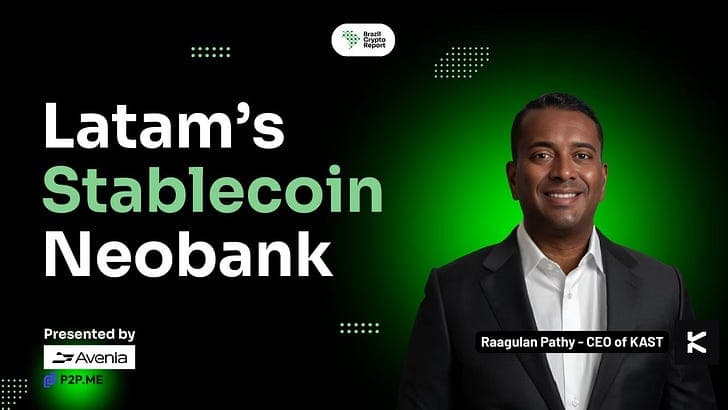
#168: How KAST Became Latam's Stablecoin Neobank with Raagulan Pathy
Sep 30, 2025·—
—
🙌 You can listen to BCR on your favorite podcast platform YouTube | Spotify | Apple Podcasts 🔥 Join the BCR English language Telegram group to continue the conversation Olá pessoal! Raagulan Pathy is CEO and founder of KAST , the stablecoin neobank has been spreading like wildfire since launching 14 months ago, particularly in emerging markets like Brazil and Latin America. Raags is known across the industry as “The Stablecoin Guy” dating back to his previous role leading Circle’s Asia operations, and he joins to shares insights into building a truly global banking alternative for the crypto-native generation. KAST represents a fundamental shift in how we think about digital banking infrastructure . Rather than simply offering another crypto card or wallet, the platform provides a comprehensive bank-like experience that bridges traditional finance with decentralized assets. Users can deposit stablecoins across multiple chains, earn yield on their holdings, and spend globally through integrated card services. Key Market Insights * Exceptional user engagement metrics : KAST has achieved 500,000 app downloads with 64% weekly active users and 30% daily active users, demonstrating strong product-market fit in the neobanking space * Rapid growth trajectory : The platform processes over US$20 million in monthly volume while maintaining 20% month-over-month growth, suggesting sustainable scaling momentum * Strategic market positioning : Latin America represents 30% of KAST’s global business, with Brazil emerging as a particularly strong market due to demand for global banking alternatives * Four distinct customer segments : The platform serves crypto natives, stablecoin-first users from the Global South, remote workers, and mobile affluent individuals who operate across multiple jurisdictions Raags’ perspective on the stablecoin ecosystem challenges conventional wisdom about where value creation occurs. While many focus on building new stablecoin protocols, he argues the real opportunity lies in creating usable infrastructure on top of existing stablecoin rails. This insight reflects a broader maturation as the industry advances from pure infrastructure development toward consumer-focused applications. The conversation also reveals important dynamics in Latin American crypto adoption, where stablecoins serve not just as remittance tools but as premium financial products for upwardly mobile consumers seeking global banking alternatives . This represents a significant market opportunity that extends well beyond traditional financial inclusion narratives. I really enjoyed this fascinating conversation and I hope you do as well. You can connect with Raags on Linkedin Have a great week everyone, -AWS Brazil Crypto Report is presented by Avenia is the programmable financial infrastructure for Latin America. Connect to local payment rails like PIX, SPEI and CBU — using stablecoins as settlement — and unlock real-time, cross-border payments without banks, FX desks, or SWIFT. Whether you’re building a wallet, a crypto card, or a global treasury solution, Avenia gives you the APIs and compliance-ready infrastructure to scale in LatAm. Move money between BRL, USD, MXN and more — fast, transparent, and fully on-chain. https://avenia.io/ P2P.me is the fastest way to buy and sell crypto in Brazil using Pix: direct, secure, and fully onchain. Backed by Multicoin and Coinbase Ventures, P2P.me offers a compliant on and off ramp with, ZK-KYC, and no hidden fees. You can easily use P2P.me to pay PIX QR codes in Brazil using your USDc balance. Topup, scan and pay. Visit br.p2p.me to get started and earn $50 per operation limit. Recent Episodes Get full access to Brazil Crypto Report at newsletter.brazilcrypto.io/subscribe

Episode #167: The Latam Road to Devconnect with Nathan Sexer and Romina Sejas
Sep 25, 2025·—
—
🙌 You can listen to BCR on your favorite podcast platform YouTube | Spotify | Apple Podcasts 🔥 Join the BCR English language Telegram group to continue the conversation Olá pessoal! Mark your calendars because Latin America will be the center of the crypto universe this November. Devconnect , Ethereum’s premier developer-focused event takes place this year in Buenos Aires from November 17-22. This gathering attracts talent from across the Ethereum world as well as competing ecosystems. Prior to that, ETH Latam will take place in Sao Paulo November 6-9 and will bring showcase the best talent and projects that the region has to offer. For today’s episode of BCR we talk to Nathan Sexer, head of Devcon and Devconnect at the Ethereum Foundation and Romina Sejas of ETH Kipu and ETH Latam to talk about how these events showcase the leading, though under-appreciated, role that Latin America plays in the growth of crypto globally. Why Latin America, Why Now? The timing couldn't be better. Argentina boasts one of the world's highest crypto adoption rates, with 5 million people - 10% of the population - using crypto daily . Meanwhile, Brazil is experiencing a a flurry of activity at the institutional level, with banks and regulators conducting deep blockchain research and exploring real-world tokenization projects. As Romina noted, "In Brazil, you don't need to explain what blockchain or Ethereum is anymore. They're already doing the research." ETH LATAM: Brazil's Institutional Moment November 6-9, São Paulo ETH Latam returns to Brazil with a focus on bridging the gap between crypto's grassroots community and institutional stakeholders. This year's event features: * Hackathon component (Nov 6-7) partnered with ETH Samba * Main conference (Nov 8-9) with multiple specialized tracks * Arbitrum Day highlighting the L2's strong Brazilian presence * Staking Forum and AI stage for specialized discussions * Institutional focus targeting banks, regulators, and corporate leaders The event serves as the perfect "stopover before Devconnect," allowing international attendees to experience both Brazil's corporate crypto landscape and Argentina's grassroots innovation. Devconnect: Reimagining Ethereum Gatherings November 17-22, Buenos Aires Devconnect differs from Devcon (also hosted by the Ethereum Foundation) and other crypto events in that it breaks the traditional conference mold, offering a hybrid experience that combines: * 30-40 coordinated events in one massive venue in Palermo * World's Fair component showcasing production-ready Ethereum applications * Co-working spaces for real-time collaboration * Gaming, privacy, and Layer 2 districts for hands-on experiences * Pay-with-crypto functionality throughout the venue The Ripple Effect The Ethereum Foundation's return to Latin America just three years after Devcon Bogotá demonstrates the region's sustained impact . The 2022 event catalyzed community growth that's still expanding today, with projects like Hardhat and OpenZeppelin originating from Argentina's vibrant builder ecosystem. Both events represent a pivotal moment: crypto's evolution from experimental technology to practical infrastructure that serves real-world needs across diverse markets. Be sure to visit ethlatam.org and devconnect.org for tickets and updates. You can connect with Romina and Nathan on X/Twitter. Have a great week everyone, -AWS Brazil Crypto Report is presented by Avenia is the programmable financial infrastructure for Latin America. Connect to local payment rails like PIX, SPEI and CBU — using stablecoins as settlement — and unlock real-time, cross-border payments without banks, FX desks, or SWIFT. Whether you're building a wallet, a crypto card, or a global treasury solution, Avenia gives you the APIs and compliance-ready infrastructure to scale in LatAm. Move money between BRL, USD, MXN and more — fast, transparent, and fully on-chain. https://avenia.io/ P2P.me is the fastest way to buy and sell crypto in Brazil using Pix: direct, secure, and fully onchain. Backed by Multicoin and Coinbase Ventures, P2P.me offers a compliant on and off ramp with, ZK-KYC, and no hidden fees. You can easily use P2P.me to pay PIX QR codes in Brazil using your USDc balance. Topup, scan and pay. Visit br.p2p.me to get started and earn $50 per operation limit. Recent Episodes Get full access to Brazil Crypto Report at newsletter.brazilcrypto.io/subscribe
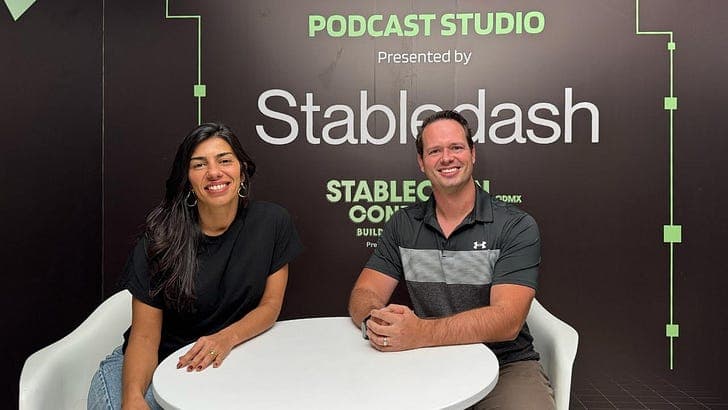
Episode #166: Thamilla Talarico on Drex and Polygon's Growth in Brazil
Sep 16, 2025·—
—
🙌 You can listen to BCR on your favorite podcast platform YouTube | Spotify | Apple Podcasts 🔥 Join the BCR English language Telegram group to continue the conversation Olá pessoal! Today’s episode is with Thamilla Talarico, head of on-chain finance growth for Brazil at Polygon Labs. You may recall that she previously represented Ernst & Young in the Central Bank’s Drex pilot. We talk about Polygon’s deliberate investment in Brazilian market expansion , recognizing the country's unique position in the Latin American digital asset ecosystem. We also dive into several important changes to Polygon’s growth strategy. Gone are the days when Starbucks and Nike were issuing NFTs on the platform. Nowadays, they are laser focused on payments and on-chain finance (RWAs). Thamilla also reflects at length about her experience working on the Drex pilot with EY. We explore about the good, bad and ugly aspects of the project, and how, ultimately blockchain privacy technology is just not ready to be deployed at the scale required by the Central Bank. Key Takeaways Regarding Polygon’s Pivot * Laser-focused vision : Polygon has shifted from being a general-purpose blockchain to specifically targeting real-world assets and payments, moving away from the scattered approach that previously included NFT partnerships and various enterprise initiatives * Market dominance in BRL stablecoins : Brazilian Real stablecoins represent the second-largest non-USD stablecoin volume on Polygon, with major issuers including BRL1 (Bitso, Mercado Bitcoin, Foxbit consortium), BRLA (Avenia), and BRZ (Transfero) * Technical infrastructure improvements : The Giga gas roadmap promises significant performance enhancements, scaling from 1,000 TPS currently to 5,000 TPS by October 2024, with eventual targets of 100,000 TPS * Geographic expansion strategy : Brazil represents one of four key markets receiving dedicated business development resources, alongside Hong Kong, India, and the UK Drex Project Reflections and Market Implications * Privacy vs. composability trade-offs : The fundamental challenge wasn't scalability, but rather balancing blockchain's inherent transparency with privacy requirements and regulatory compliance under Brazilian data protection laws * Technical maturity gaps : None of the three privacy solutions tested in Phase One met the Central Bank's production-ready standards, highlighting the nascent state of enterprise-grade privacy technologies * Regulatory complexity : The Central Bank struggled to reconcile blockchain's transparency with compliance requirements, particularly around data protection and the balance between audit capabilities and broad surveillance powers * Positive externalities : Despite the pivot, the project successfully matured Brazil's digital assets ecosystem, creating technical expertise, fostering collaboration between competitors, and establishing business relationships that will continue beyond Drex Moving forward , Thamilla emphasizes that the infrastructure, knowledge, and business cases developed during the Drex pilot remain valuable. The focus should shift toward private sector initiatives using stablecoins as settlement instruments for tokenized assets, leveraging the collaborative frameworks and technical expertise developed during the pilot program. The Central Bank's decision represents a natural transition from public sector experimentation to private sector implementation, she argues, positioning Brazil to maintain its leadership in tokenization while building on the substantial groundwork laid by the Drex initiative. You can connect with Thamilla on Linkedin. Have a great week everyone, -AWS Brazil Crypto Report is presented by Avenia is the programmable financial infrastructure for Latin America. Connect to local payment rails like PIX, SPEI and CBU — using stablecoins as settlement — and unlock real-time, cross-border payments without banks, FX desks, or SWIFT. Whether you're building a wallet, a crypto card, or a global treasury solution, Avenia gives you the APIs and compliance-ready infrastructure to scale in LatAm. Move money between BRL, USD, MXN and more — fast, transparent, and fully on-chain. https://avenia.io/ P2P.me is the fastest way to buy and sell crypto in Brazil using Pix: direct, secure, and fully onchain. Backed by Multicoin and Coinbase Ventures, P2P.me offers a compliant on and off ramp with, ZK-KYC, and no hidden fees. You can easily use P2P.me to pay PIX QR codes in Brazil using your USDc balance. Topup, scan and pay. Visit br.p2p.me to get started and earn $50 per operation limit. Recent Episodes Get full access to Brazil Crypto Report at newsletter.brazilcrypto.io/subscribe
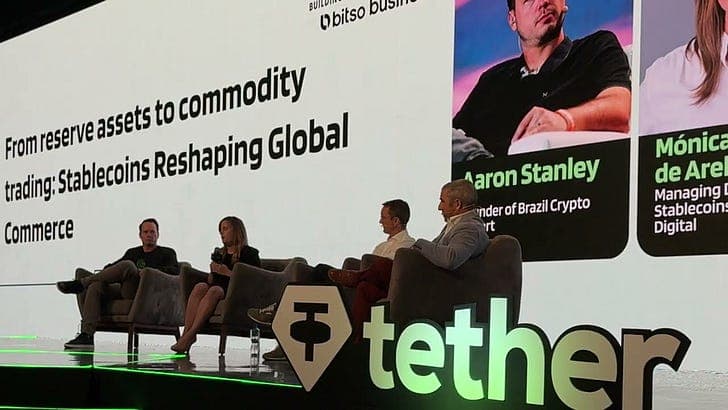
Episode #165: Stablecoins Reshaping Global Commerce - Onsite from the Bitso Stablecoin Conference
Sep 11, 2025·—
—
🙌 You can listen to BCR on your favorite podcast platform YouTube | Spotify | Apple Podcasts 🔥 Join the BCR English language Telegram group to continue the conversation Olá pessoal! Today’s podcast episode is a panel discussion I moderated at Bitso Business’ Stablecoin Conference in Mexico City, featuring Monica Ramirez (Anchorage Digital), Nick Philpott (Zodiac Markets), and Peter Wexler (Visa). Our conversation explored how stablecoins have evolved from crypto trading tools to essential infrastructure for global commerce. We highlight critical regulatory developments, particularly the U.S. Genesis Act, which have opened doors for mainstream adoption by providing the regulatory clarity banks and institutions have long sought. This legislation, combined with similar frameworks like Europe's MiCA, is creating a foundation for global stablecoin commerce. Key Themes Discussed: * Commodities Financing Revolution : Zodia Markets processes $30-40 billion annually in USD stablecoins, with individual transactions reaching $155 million for oil cargo purchases, demonstrating stablecoins' capacity for large-scale commodity trading * Correspondent Banking Decline : The retreat of traditional banking networks has created opportunities for stablecoin infrastructure to fill critical gaps in cross-border payments * Emerging Market Innovation : Non-USD stablecoins like Turkish Lira (TRYB) are finding product-market fit, with Zodiac processing nearly $3 billion in TRYB year-to-date * Banking Strategy : Rather than issuing stablecoins directly, banks should focus on providing services to issuers—custody, treasury management, and minting/burning operations * User Experience : The panel emphasized creating "Uber-like" transparency in cross-border payments to reduce psychological costs and uncertainty Market predictions ranged from $1-9 trillion in stablecoin market cap by 2030, with consensus around $2-5 trillion representing a 10x growth from current levels. Huge thanks to the Bitso Business team for the opportunity to participate in this great event! Feel free to connect with Monica , Nick and Peter on Linkedin. Have a great week everyone, -AWS Brazil Crypto Report is presented by Avenia is the programmable financial infrastructure for Latin America. Connect to local payment rails like PIX, SPEI and CBU — using stablecoins as settlement — and unlock real-time, cross-border payments without banks, FX desks, or SWIFT. Whether you're building a wallet, a crypto card, or a global treasury solution, Avenia gives you the APIs and compliance-ready infrastructure to scale in LatAm. Move money between BRL, USD, MXN and more — fast, transparent, and fully on-chain. https://avenia.io/ P2P.me is the fastest way to buy and sell crypto in Brazil using Pix: direct, secure, and fully onchain. Backed by Multicoin and Coinbase Ventures, P2P.me offers a compliant on and off ramp with, ZK-KYC, and no hidden fees. You can easily use P2P.me to pay PIX QR codes in Brazil using your USDc balance. Topup, scan and pay. Visit br.p2p.me to get started and earn $50 per operation limit. Recent Episodes Get full access to Brazil Crypto Report at newsletter.brazilcrypto.io/subscribe
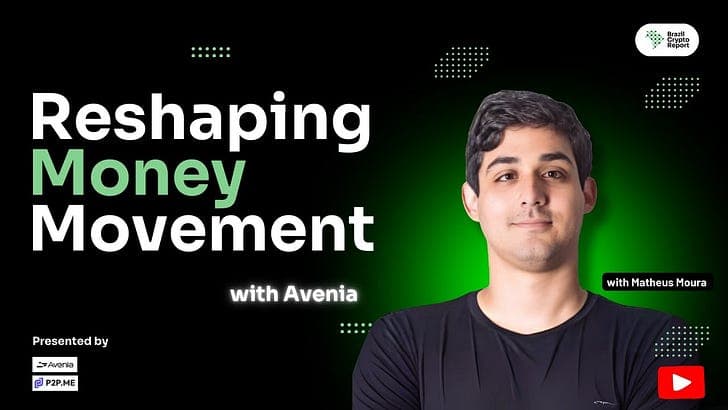
Episode #164: Reshaping Money Movement in Latam with Matheus Moura
Sep 5, 2025·—
—
🙌 You can listen to BCR on your favorite podcast platform YouTube | Spotify | Apple Podcasts 🔥 Join the BCR English language Telegram group to continue the conversation Olá pessoal! This week’s episode is with Matheus Moura, co-founder and CEO of Avenia (formerly BRLA Digital), where we discuss how the company is building out cross-border payments and financial infrastructure across Latin America. We touch on the need for this infrastructure under the thesis that every company will eventually become a financial services company in some capacity . We also explore the role of stablecoins in the embedded finance landscape and why Latin America has emerged as ground zero for this transformation. Avenia is also a sponsor of Brazil Crypto Report so be sure to check them out 🔥 BRLA Digital → Avenia Avenia started off as a quantitative crypto hedge fund, but quickly transitioned in 2023 to focus on financial infrastructure upon realizing the strong product market fit opportunity in the crypto payments space. What started as an idea to create dollar savings accounts for Brazilians has evolved into a comprehensive platform that enables any company to offer financial services through a single API integration. The company's rebrand to Avenia (from " avenida " - avenue in Spanish/Portuguese) perfectly captures their mission: building financial highways for seamless money movement across borders. This infrastructure approach addresses a critical market need, as evidenced by the fact that 90% of Avenia's current revenue comes from cross-border FX transactions. Key Takeaways * The End of "Not Moving Money" : Matheus describes how traditional solutions like Wise rely on maintaining cash pools across markets to avoid actual money movement. Stablecoins enable real-time, low-cost transfers that eliminate the need for inefficient balance sheet management. * Latin America's Perfect Storm : The region's combination of instant payment systems (Pix, SPEI), sophisticated user expectations for real-time transfers, and complex correspondent banking relationships creates ideal conditions for stablecoin adoption. * Embedded Finance at Scale : Avenia's vision extends beyond FX to recreating all financial primitives (credit, investing, escrow) through stablecoins, enabling any company to become a financial services provider. Matheus sees this as similar to how cloud computing has democratized tech infrastructure over the last 20 years. * Regulatory Readiness : Brazil's central bank's collaborative approach to innovation, combined with upcoming VASP regulations, positions the country as a leader in crypto-friendly financial infrastructure development. * Regional Expansion Strategy : Success in Brazil provides the foundation for Avenia’s expansion across Latin America, with Argentina, Colombia, and Mexico identified as priority markets based on client demand and regulatory frameworks. Pushing Forward Avenia's roadmap includes expanding payment methods, card issuance capabilities, and additional financial primitives while maintaining focus on reducing complexity for companies entering Latin American markets. As Matheus noted, the goal is creating an environment where "everyone can pay like a local in any country of Latin America" regardless of their native currency. The company's approach represents a fundamental shift in how we think about cross-border payments - from managing liquidity pools to enabling actual money movement through blockchain rails. For financial services stakeholders, Avenia's growth trajectory offers valuable insights into the future of embedded finance in emerging markets. I really enjoyed this conversation with Matheus and I hope you do as well. You can connect with him on Linkedin . Have a great week everyone, -AWS Brazil Crypto Report is presented by Avenia is the programmable financial infrastructure for Latin America. Connect to local payment rails like PIX, SPEI and CBU — using stablecoins as settlement — and unlock real-time, cross-border payments without banks, FX desks, or SWIFT. Whether you're building a wallet, a crypto card, or a global treasury solution, Avenia gives you the APIs and compliance-ready infrastructure to scale in LatAm. Move money between BRL, USD, MXN and more — fast, transparent, and fully on-chain. https://avenia.io/ P2P.me is the fastest way to buy and sell crypto in Brazil using Pix: direct, secure, and fully onchain. Backed by Multicoin and Coinbase Ventures, P2P.me offers a compliant on and off ramp with, ZK-KYC, and no hidden fees. You can easily use P2P.me to pay PIX QR codes in Brazil using your USDc balance. Topup, scan and pay. Visit br.p2p.me to get started and earn $50 per operation limit. Recent Episodes Get full access to Brazil Crypto Report at newsletter.brazilcrypto.io/subscribe
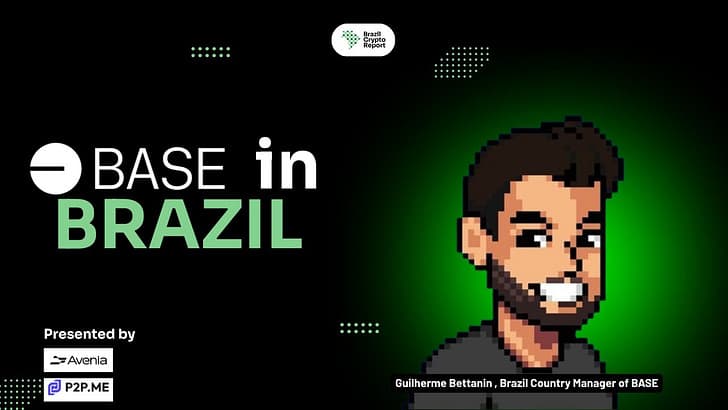
Episode #163: Base in Brazil with Guilherme Bettanin
Aug 27, 2025·—
—
🙌 You can listen to BCR on your favorite podcast platform YouTube | Spotify | Apple Podcasts 🔥 Join the BCR English language Telegram group to continue the conversation Olá pessoal! This week’s episode is with Guilherme Bettanin, Brazil country manager for Base - the Coinbase-incubated Ethereum Layer 2 blockchain that has become the largest network of its kind based on transaction volume, users and total value locked. We discuss Gui’s ambitious expansion strategy designed to establish Brazil as a cornerstone of Base’s Latin America ecosystem. The goal is to position Base as Brazil's largest blockchain community while addressing the diverse needs of the local ecosystem. This approach includes supporting various sophistication levels within the Brazilian market, from established enterprise projects to emerging individual developers seeking entry points into decentralized finance, for example. Objectives Include: * Market Positioning : Establish Base as the dominant blockchain community platform in Brazil * Ecosystem Development : Support both large-scale institutional projects and grassroots innovation * Educational Infrastructure : Provide guidance and resources for newcomers to the cryptocurrency space * Regional Expansion : Leverage growth in Brazil to drive broader Latin American adoption Ambassador Network and Specialized Expertise Gui is also making a big push to expand the Base community via ambassador programs that taps into specialized knowledge areas. These include: * Ambassador Program : Curated selection of regional experts and thought leaders * Builder Network : Direct support system for developers and technical contributors * Creator Economy Focus : Specialized guidance for content creators and digital entrepreneurs * Knowledge Exchange : Facilitated learning between experienced and emerging participants Community Engagement Strategy Base brings a multi-channel approach to community development, combining digital presence with direct engagement opportunities. This includes a big focus on in-person events and virtual programming, an aggressive social media presence with active content distribution on social networks, a buzzing Discord community and open collaboration with participants from other blockchain ecosystems. I really enjoyed this conversation with Guilherme and I hope you do as well. You can connect with him on X/Twitter . Be sure to follow Based Brasil on X as well, and join the Base Brasil Discord server to follow this exciting ecosystem. Have a great week everyone, -AWS Brazil Crypto Report is presented by Avenia is the programmable financial infrastructure for Latin America. Connect to local payment rails like PIX, SPEI and CBU — using stablecoins as settlement — and unlock real-time, cross-border payments without banks, FX desks, or SWIFT. Whether you're building a wallet, a crypto card, or a global treasury solution, Avenia gives you the APIs and compliance-ready infrastructure to scale in LatAm. Move money between BRL, USD, MXN and more — fast, transparent, and fully on-chain. https://avenia.io/ P2P.me is the fastest way to buy and sell crypto in Brazil using Pix: direct, secure, and fully onchain. Backed by Multicoin and Coinbase Ventures, P2P.me offers a compliant on and off ramp with, ZK-KYC, and no hidden fees. You can easily use P2P.me to pay PIX QR codes in Brazil using your USDc balance. Topup, scan and pay. Visit br.p2p.me to get started and earn $50 per operation limit. Recent Episodes Get full access to Brazil Crypto Report at newsletter.brazilcrypto.io/subscribe

Episode #162: Drex Without Blockchain? Exploring the Road Ahead with Gustavo Cunha and Marcos Sarres
Aug 20, 2025·—
—
🙌 You can listen to BCR on your favorite podcast platform YouTube | Spotify | Apple Podcasts 🔥 Join the BCR English language Telegram group to continue the conversation Olá pessoal! Brazil’s Central Bank shook the market earlier this month by announcing that it remove the blockchain component of the Drex project (at least in the short term). The project will now pivot to focus on unlocking collateral via lien reconciliation using a non-blockchain solution. The Drex project has been the driver of much of the blockchain activity in the country over the last couple years. So what does this pivot mean: is it a rug pull? or a moment for the private sector to take the lead and continue generating momentum? To discuss, I am joined by Gustavo Cunha , CEO of Fintrender and a former Brazilian banking executive, and Marcos Sarres , CEO of GoLedger - a firm specializing in blockchain development on Hyperledger. Both Gustavo and Marcos have been following the Drex project in different capacities since its initiation in 2021 , and offer valuable perspective on why blockchain did not work out as planned for Drex (at least not yet), and the road ahead for blockchain in Brazil without Drex as the driving force. Brazil Crypto Report is a media partner of Stablecoin Conference 2025, hosted by Bitso Business on August 27-28 in Mexico City Motives Behind the Pivot The core reasons for pulling the plug on blockchain here are multi-faceted, but ultimately boiled down to technical constraints. Specifically: * Ethereum's inherent transparency conflicted with unique multi-bank privacy requirements. Banks in the Drex network required transaction isolation while maintaining Central Bank supervisory visibility * Privacy preserving technologies like zero-knowledge proofs and homomorphic encryption solutions have extended development timelines and are not yet ready for the scale of a project like Drex * Collaborative efforts by Microsoft, Parfin, and other major players to solve this problem ultimately proved too time-intensive Gustavo notes that the pivot decision was also in part to some other factors: * The United States' movement toward regulated private stablecoins and away from centralized CBDCs * Leadership changes at the Central Bank (Drex champion Roberto Campos Neto is out as president) * The recent Pix security incident at the Central Bank, necessitating increased focus on cybersecurity A Net Positive? While the pivot decision may feel like a rug pull, Drex has advanced the blockchain and tokenization space in Brazil in many ways . Consider: * Major financial institutions developed internal blockchain teams (20-30 specialists each) * Multiple tokenization projects are now in development across carbon credits, loans, and collateral * The private sector gained substantial blockchain expertise through Drex participation * Market readiness for tokenized asset infrastructure significantly improved Still, the vacuum created by the Central Bank's withdrawal presents both challenges and opportunities . Gustavo and Marcos suggest the most likely scenario involves private sector collaboration to develop blockchain infrastructure, potentially through banking associations like Febraban. However, this approach faces coordination challenges, particularly around developing a Brazilian real stablecoin where competing banks must agree on float distribution, interoperability, governance and revenue-sharing models, etc. I enjoyed this timely conversation with Gustavo and Marcos and I hope you do as well. You can connect with both of them on Linkedin. -AWS Brazil Crypto Report is presented by Avenia is the programmable financial infrastructure for Latin America. Connect to local payment rails like PIX, SPEI and CBU — using stablecoins as settlement — and unlock real-time, cross-border payments without banks, FX desks, or SWIFT. Whether you're building a wallet, a crypto card, or a global treasury solution, Avenia gives you the APIs and compliance-ready infrastructure to scale in LatAm. Move money between BRL, USD, MXN and more — fast, transparent, and fully on-chain. https://avenia.io/ P2P.me is the fastest way to buy and sell crypto in Brazil using Pix: direct, secure, and fully onchain. Backed by Multicoin and Coinbase Ventures, P2P.me offers a compliant on and off ramp with, ZK-KYC, and no hidden fees. You can easily use P2P.me to pay PIX QR codes in Brazil using your USDc balance. Topup, scan and pay. Visit br.p2p.me to get started and earn $50 per operation limit. Recent Episodes Get full access to Brazil Crypto Report at newsletter.brazilcrypto.io/subscribe
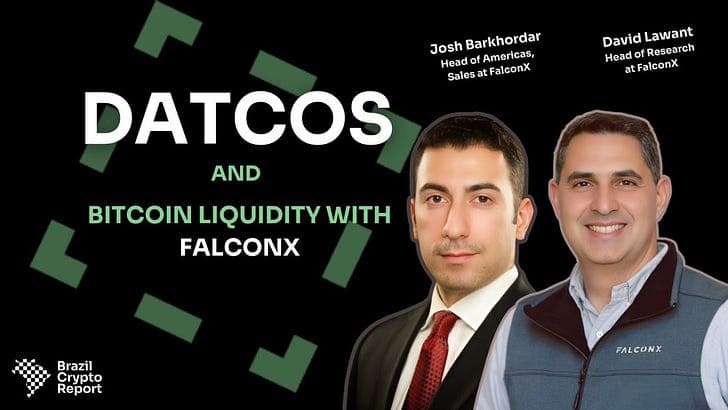
Episode #161: DATCOs and Bitcoin Liquidity with David Lawant and Josh Barkhordar
Aug 14, 2025·—
—
🙌 You can listen to BCR on your favorite podcast platform YouTube | Spotify | Apple Podcasts 🔥 Join the BCR English language Telegram group to continue the conversation Olá pessoal! Today’s episode is with David Lawant and Josh Barkhordar, Head of Research and Head of Sales, respectively, at FalconX - one of crypto’s premier institutional prime brokerage firms. FalconX's recently launched services in Brazil via partnerships with BTG Pactual and Mercado Bitcoin , and it plans on being a relevant player in the market moving ahead. The prime broker now offers its comprehensive suite of services including spot trading, derivatives, custody, FX trading, and credit facilities to Brazilian institutions. What makes Brazil particularly attractive isn't just its massive retail crypto market, but its surprisingly advanced institutional infrastructure. As David noted, Brazilian banks like BTG have been engaged with crypto for years, offering their own exchange and custody services - a level of institutional penetration that in some ways exceeds what we see in traditional U.S. financial institutions. We expand the conversation to cover crypto trends in 2025, principally the explosion of Digital Asset Treasury Companies (DATCOs) . Unlike the previous cycle's limited and over-used GBTC trade, these new vehicles offer enhanced exposure through sophisticated strategies including covered call-writing, bitcoin-backed lending, and leveraged acquisition programs. David and Josh explain how regulatory uncertainty diminishing under the current administration has opened the floodgates for hundreds of these companies to emerge. Perhaps most significantly, the Trump administration's crypto-friendly policies are creating unprecedented opportunities in the US and abroad . The recent decision to allow crypto assets in 401(k) plans, for example could unlock access to a US$9 trillion market, representing a paradigm shift comparable to the spot ETF launches. Brazil Crypto Report is a media partner of Stablecoin Conference 2025, hosted by Bitso Business on August 27-28 in Mexico City Key Takeaways from this Episode: * Brazil's institutional crypto market is more sophisticated than many realize , with major banks offering comprehensive crypto services * Stablecoin adoption has reached "escape velocity" in Latin America, driven by real economic needs for cross-border payments and inflation hedging * Digital Asset Treasury Companies represent a structural shift that offer enhanced returns through sophisticated financial strategies * The 401(k) crypto ruling could be transformational , potentially channeling steady institutional flows from a US$9 trillion market * Regulatory clarity is accelerating institutional adoption , with traditional financial institutions now comfortable entering the space * Bitcoin-backed lending is emerging as a key service for companies wanting liquidity without triggering taxable events I enjoyed this conversation with David and Josh and I hope you do as well. You can connect with both of them on Linkedin. -AWS Brazil Crypto Report is presented by Avenia is the programmable financial infrastructure for Latin America. Connect to local payment rails like PIX, SPEI and CBU — using stablecoins as settlement — and unlock real-time, cross-border payments without banks, FX desks, or SWIFT. Whether you're building a wallet, a crypto card, or a global treasury solution, Avenia gives you the APIs and compliance-ready infrastructure to scale in LatAm. Move money between BRL, USD, MXN and more — fast, transparent, and fully on-chain. https://avenia.io/ P2P.me is the fastest way to buy and sell crypto in Brazil using Pix: direct, secure, and fully onchain. Backed by Multicoin and Coinbase Ventures, P2P.me offers a compliant on and off ramp with, ZK-KYC, and no hidden fees. You can easily use P2P.me to pay PIX QR codes in Brazil using your USDc balance. Topup, scan and pay. Visit br.p2p.me to get started and earn $50 per operation limit. Recent Episodes Get full access to Brazil Crypto Report at newsletter.brazilcrypto.io/subscribe
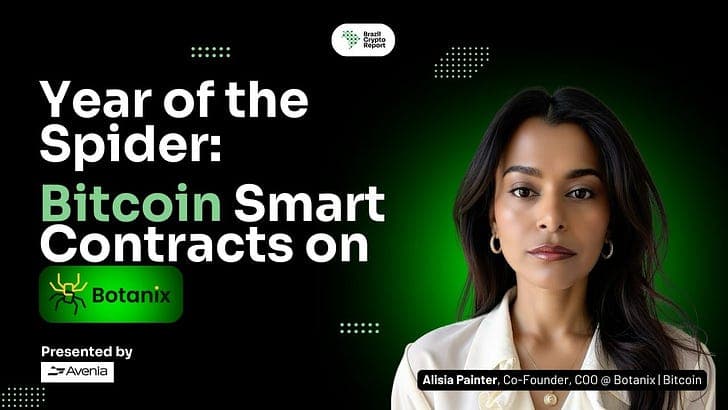
Episode #160: Smart Contracts on Bitcoin with Alisia Painter of Botanix
Aug 9, 2025·—
—
🙌 You can listen to BCR on your favorite podcast platform YouTube | Spotify | Apple Podcasts 🔥 Join the BCR English language Telegram group to continue the conversation Olá pessoal! For today’s episode I’m joined by Alisia Painter, who is co-founder and COO of Botanix Labs — which has built a new bitcoin-based blockchain focused on powering the bitcoin economy. The Botanix mainnet launched on July 1 with the goal of bringing financial products to bitcoin via EVM-compatibility and smart contract programmability. Alisia’s journey into bitcoin began in Brazil in 2015 when she was working for a Brazilian company in Sao Paulo. She was receiving salary in BRL and discovered bitcoin as a way to protect herself against the depreciating currency while easily remitting funds back to her home country of Canada. That experience, and later time spent in Asia and Africa, shaped her bitcoin worldview and motivated her to pursue bringing financial use cases and products to bitcoin. Key Themes from Our Conversation: * Real-world bitcoin use cases : Unlike theoretical discussions, Alicia's perspective comes from seeing actual monetary instability and the urgent need for sound money in developing economies * The Spiderchain innovation : Botanix's unique proof-of-stake blockchain, built on top of Bitcoin's proof-of-work consensus, creates a decentralized network of multi-sigs that enables programmability while maintaining bitcoin's core principles * Cultural shift in bitcoin : The ETF approval has fundamentally changed who bitcoiners are - from hardcore HODLers to mainstream investors buying on Robinhood who want to put their bitcoin to work * EVM equivalence on bitcoin : Developers can copy-paste battle-tested smart contracts from Ethereum directly onto Botanix, bringing DeFi's entire ecosystem to Bitcoin with proven security * Bitcoin's maturation : As bitcoin becomes less volatile and capital gains moderate, the need for financialization and yield generation becomes more critical * Institutional interest : Major financial firms are showing significant interest in Botanix because institutions ultimately denominate everything in Bitcoin Building the Bitcoin Economy What makes Botanix particularly compelling is their ecosystem-first approach. Rather than just building infrastructure and hoping developers will come, they've incubated native applications from day one - DEXs like Arch and Bitsy, lending protocols like Dolomite, and even GMX deploying their battle-tested perpetuals platform. Their vision extends beyond DeFi to imagine a complete bitcoin-based economy, visualized in their creative "2100 Bitcoin World" website - a Simpsons’-themed city where every building represents a different application in their ecosystem. Brazilian Connections Throughout our bilingual conversation, Alicia emphasizes the natural fit between bitcoin DeFi and Brazilian markets, noting strong community interest and the presence of Portuguese-speaking resources in their Discord community. As Botanix launches its mainnet and prepares to introduce yield-bearing bitcoin (STBTC) next month, they're positioning themselves not just as another bitcoin layer-2, but as the foundation for bitcoin's evolution from digital gold to the backbone of a new financial system. I enjoyed this conversation with Alisia. You can connect with her on X/Twitter and on Linkedin . -AWS Brazil Crypto Report is presented by Avenia is the programmable financial infrastructure for Latin America. Connect to local payment rails like PIX, SPEI and CBU — using stablecoins as settlement — and unlock real-time, cross-border payments without banks, FX desks, or SWIFT. Whether you're building a wallet, a crypto card, or a global treasury solution, Avenia gives you the APIs and compliance-ready infrastructure to scale in LatAm. Move money between BRL, USD, MXN and more — fast, transparent, and fully on-chain. https://avenia.io/ P2P.me is the fastest way to buy and sell crypto in Brazil using Pix: direct, secure, and fully onchain. Backed by Multicoin and Coinbase Ventures, P2P.me offers a compliant on and off ramp with, ZK-KYC, and no hidden fees. You can easily use P2P.me to pay PIX QR codes in Brazil using your USDc balance. Topup, scan and pay. Visit br.p2p.me to get started and earn $50 per operation limit. Recent Episodes Get full access to Brazil Crypto Report at newsletter.brazilcrypto.io/subscribe
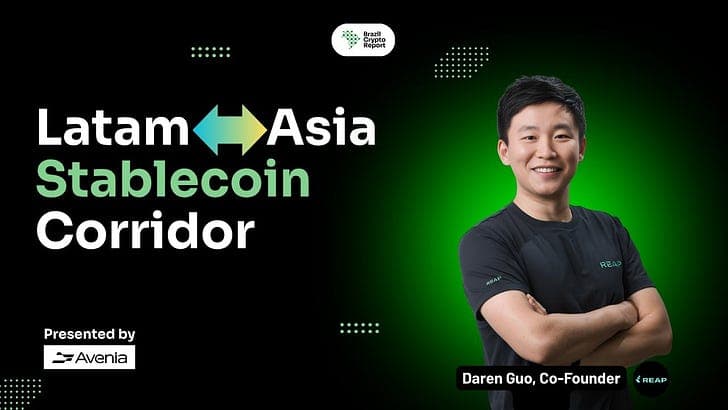
Episode #159: The Latam <-> Asia Stablecoin Corridor with Reap co-founder Daren Guo
Aug 3, 2025·—
—
🙌 Friendly reminder that you can listen to BCR on your favorite podcast platform YouTube | Spotify | Apple Podcasts 🔥 Join the BCR English language Telegram group to continue the conversation Olá pessoal! Our guest for this week is Daren Guo, co-founder of Reap, a Hong Kong-based fintech. We discuss Reap’s role as a payments infrastructure provider focused on connecting Asia and other emerging markets like Brazil and Latin America. Drawing from his experience as an early Stripe employee who helped scale the company from 90 to 2,000 employees, Daren outlined Reap’s vision for creating accessible, internet-native financial infrastructure powered by stablecoins. The Problem: Financial Access Inequality Daren highlighted a fundamental challenge for businesses and individuals in emerging markets: accessing stable, USD-denominated financial services. As we’ve explored on this show in depth, he notes that traditional cross-border payment systems are plagued by inefficiencies — as Guo noted: "I can fly to Brazil before my money lands there." This reality creates significant barriers for businesses operating across borders, particularly in the Global South where corresponding banking networks are often unreliable and costly. Reap’s Solution: Three-Pillar Approach Reap addresses these challenges through a comprehensive stablecoin-native infrastructure that supports three core product lines: * White-labeled stablecoin card-as-a-service platform for modern neobanks to issue stablecoin-backed cards * Cross-border payments platform enabling trade financing and import-export operations with multi-currency payouts * Financial operations platform connecting stablecoin treasury to business expenses through corporate cards and bill payments Strategic Advantages in Asia Operating out of Hong Kong provides Reap with unique advantages in serving global markets. Through this, the company is able to offer multi-currency infrastructure supporting up to 14 different currencies, superior SWIFT access, and presence in a regulatory framework that embraces stablecoin innovation. Further, Hong Kong's ability to clear USD transactions outside US banking hours exemplifies the operational benefits of this geographic positioning. Market Evolution and Customer Growth Launch as a traditional fintech play in 2018, Daren and Reap made the call to go all in on stablecoin infrastructure in 2021. Since then, the platform has witnessed significant evolution in customer profiles. For example, Reap initially serviced crypto-native businesses like centralized exchanges, but has expanded to support traditional trade financing, import-export platforms, and SMEs across Latin America and Africa. This shift reflects broader market maturation toward practical, real-world utility rather than purely speculative use cases. Regulatory Tailwinds We discuss the freshly passed Genius Act in the United States, which represents a watershed moment for stablecoin infrastructure globally. Daren emphasized that such legislation provides crucial clarity for platforms building in this space while creating positive spillover effects in other markets. However, he advocates for nuanced regulatory approaches that recognize different risk profiles across various stablecoin use cases. Looking Forward With Latin America as Reap’s fastest-growing market, the company is actively expanding its regional presence and capabilities. Daren concluded: "We're in the early innings of this journey toward a tokenized economy.” I enjoyed this conversation with Daren and I hope you do as well. You can connect with him on Linkedin . -AWS Brazil Crypto Report is presented by Avenia is the programmable financial infrastructure for Latin America. Connect to local payment rails like PIX, SPEI and CBU — using stablecoins as settlement — and unlock real-time, cross-border payments without banks, FX desks, or SWIFT. Whether you're building a wallet, a crypto card, or a global treasury solution, Avenia gives you the APIs and compliance-ready infrastructure to scale in LatAm. Move money between BRL, USD, MXN and more — fast, transparent, and fully on-chain. https://avenia.io/ P2P.me is the fastest way to buy and sell crypto in Brazil using Pix: direct, secure, and fully onchain. Backed by Multicoin and Coinbase Ventures, P2P.me offers a compliant on and off ramp with, ZK-KYC, and no hidden fees. You can easily use P2P.me to pay PIX QR codes in Brazil using your USDc balance. Topup, scan and pay. Visit br.p2p.me to get started and earn $50 per operation limit. Recent Episodes Get full access to Brazil Crypto Report at newsletter.brazilcrypto.io/subscribe
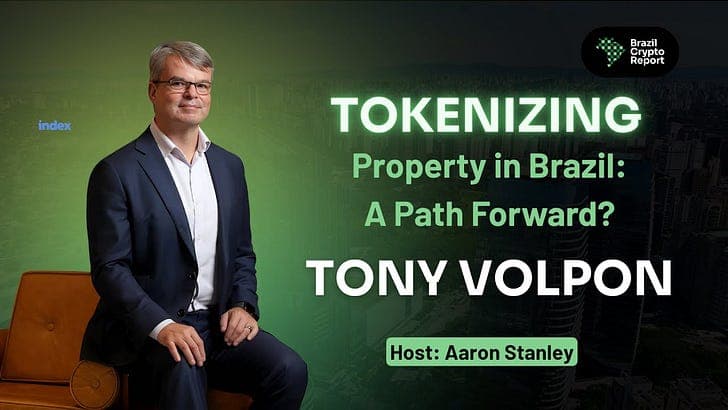
Episode #158: Tony Volpon on Bitcoin, Macro and Real Estate Tokenization in Brazil
Jul 18, 2025·—
—
🙌 Friendly reminder that you can listen to BCR on your favorite podcast platform YouTube | Spotify | Apple Podcasts 🔥 Join the BCR English language Telegram group to continue the conversation Olá pessoal! Tony Volpon is a former banking executive and deputy governor of the Central Bank of Brazil turned crypto entrepreneur. He joins the show today to chat about his red pill moment and how he went down the bitcoin rabbit hole, the role of bitcoin in Brazil from a macro perspective and also his efforts to tokenize Brazil's real estate market through his company CF Inovação - which is building the Index marketplace. With nearly 25 years in banking and a front-row seat to Brazil's economic challenges over the last several decades, Tony offers an incredible persective. The Macro Context: Why Bitcoin Matters in the Global Economic Backdrop His journey into crypto began during his tenure at Brazil's central bank. There, he witnessed firsthand the limitations of traditional financial systems and how an asset like bitcoin can serve against systemic governance failures — even in historically stable economies like the United States. We spend some time comparing the fiscal situations of the US and Brazil, respectively: * Debt Crisis Reality : Even with some attempts to cut spending in the US this year, the country’s debt now surpasses US$37 trillion. Unless there is a miraculous productivity boost from AI, this debt will likely need to be inflated away * The "Brazilianization" of Global Markets : Risk premiums are becoming necessary even for traditionally "safe" assets like US Treasuries * Political Flexibility Paradox : Brazil may actually have more political capacity for fiscal reform than the United States Tokenized Real Estate: The Holy Grail While countless tokenized real estate projects have sprouted up and vanished over the past decade, Volpon believes he has the right ingredients for success in Brazil - namely buy-in from the right regulators and a partnership with Netspaces. CF Inovação has created a comprehensive ecosystem to tokenize Brazil's real estate market, built on four foundational elements: 1. Digital Contract Registry (SGR) * A system for on-chain contract storage that puts all real estate contracts directly on blockchain rather than relying on external trusts or notaries * Direct integration with government auditing infrastructure , allowing COFECI's 3,000 auditors to verify and monitor tokenized projects in real-time 2. Regulatory Framework * CF is collaborating with COFECI (Brazil's real estate regulator) to create specific tokenization regulations that establish legal clarity for all market participants including brokers, developers, and token buyers 3. Commercial Infrastructure * The company is creating a platform for developers and brokers that provides a unified interface for listing tokenized real estate projects and managing the entire sales process * This platfform would allow access to Brazil’s 450,000 registered brokers, who could serve as a potential sales force 4. Token Marketplace Partnership * CF is partnering with NetSpaces for deed tokenization that enables trading of property ownership through tokens (while keeping the actual deed frozen in a legal depository) * This solution would be viable for both pre-construction forward contracts and existing properties , covering the entire real estate lifecycle from development to resale Market Impact and Global Implications The platform addresses critical pain points in Brazil's real estate market, where transaction costs can reach 10% of property value . By reducing these costs and creating unprecedented liquidity, the solution could: * Enable international investment through stablecoin integration * Provide alternative financing for underserved regional developers * Create a secondary market for pre-construction investments * Establish a regulatory model for global adoption Looking Ahead : With regulatory approval expected soon and a beta launch planned for year-end, Volpon's vision represents potentially the world's first comprehensive, regulator-backed real estate tokenization ecosystem . As he notes, "Real estate is by far the biggest asset class in the world, it's totally illiquid, and it's mostly inaccessible. To bring that into [tokenization] could be really revolutionary." I really enjoyed this conversation with Tony and I hope you do as well. You can connect with him on Linkedin -AWS Brazil Crypto Report is presented by Avenia is the programmable financial infrastructure for Latin America. Connect to local payment rails like PIX, SPEI and CBU — using stablecoins as settlement — and unlock real-time, cross-border payments without banks, FX desks, or SWIFT. Whether you're building a wallet, a crypto card, or a global treasury solution, Avenia gives you the APIs and compliance-ready infrastructure to scale in LatAm. Move money between BRL, USD, MXN and more — fast, transparent, and fully on-chain. https://avenia.io/ Recent Episodes
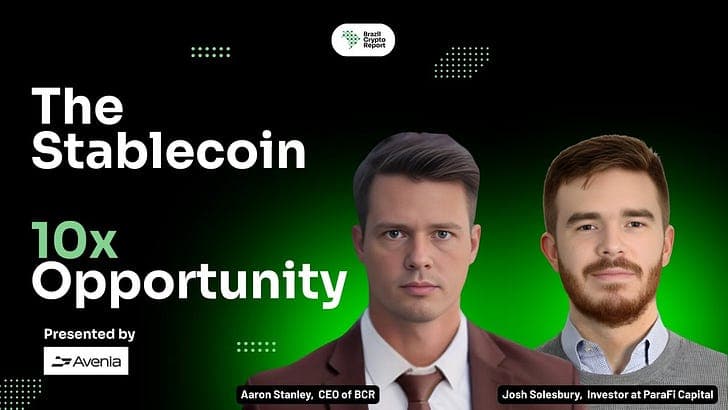
Episode #157: The Stablecoin 10x Opportunity with ParaFi Capital's Josh Solesbury
Jul 9, 2025·—
—
🙌 Friendly reminder that you can listen to BCR on your favorite podcast platform YouTube | Spotify | Apple Podcasts Olá pessoal! Stablecoins are obviously one of the key trends in crypto in 2025, and it’s a topic we’ve covered a decent amount here on BCR. However, we’ve yet to take a deep look into why this innovation is so important, especially for emerging markets in regions like Latin America. To help us break this down the full stablecoin value proposition, particularly as it pertains to cross-border payments, Josh Solesbury — an investor at ParaFi Capital — one of crypto’s largest VC firms, joins the show. Josh has researched extensively the pain points in the global correspondent banking system and articulates persuasively why stablecoins represent the most significant opportunity to modernize global payment infrastructure. The $150 Trillion Opportunity Cross-border B2B payments represent one of the largest economic systems globally, settling approximately $150 trillion annually. Yet this massive market operates on infrastructure that hasn't meaningfully evolved in 50 years , as the the SWIFT correspondent banking system, creates a web of inefficiencies that cost businesses dearly. Key Pain Points in Traditional Cross-Border Payments: * High costs : Average fees of 4-6% across international corridors * Lengthy settlement times : 2-5 days on average, with 40% of Latin American transactions experiencing delays of five days or more * Trapped capital : $12 billion in working capital stuck in B2B payment corridors, representing roughly 10% of volume * Opacity : Limited visibility into exchange rates and processing status throughout the transaction lifecycle Correspondent Banking Bottleneck Traditional international payments require multiple intermediary banks, each adding their own margins and compliance checks. For example, a payment from the UK to Brazil might route through three different institutions, with each bank conducting anti-money laundering reviews, applying foreign exchange spreads, and adhering to different business day schedules. What should be a minutes-long, penny-cost transaction becomes a multi-day, expensive ordeal. Latin America: The Perfect Testing Ground Josh identifies Latin America as an ideal region for stablecoin adoption, citing two critical factors: Economic Friction: * Higher cross-border fees (6% average vs. lower rates in developed markets) * 70% of the population remains underbanked or unbanked * Currency volatility creates additional hedging costs for businesses Market Readiness: * Highest payments revenue growth globally (3x the global average) * 40% of population under 25 with 75%+ mobile penetration * Existing digital payment infrastructure (like Brazil's PIX) creates natural adoption pathway The Infrastructure Convergence From the macro point of view, three key developments are enabling the stablecoin payment revolution: Regulatory Clarity: The U.S. Genius Act and similar legislation provide legal framework for stablecoin adoption by traditional financial institutions. Technical Infrastructure: Improved wallet creation, blockchain scalability, and fintech-friendly tools are reducing barriers to entry. Liquidity Solutions: Major banks entering the space will provide the liquidity depth necessary for large-scale B2B transactions. Beyond Cost Savings: Programmable Money Finally, we discuss how stablecoins offer advantages beyond efficiency gains. Smart contract programmability enables automated payroll distribution, dynamic yield optimization, and integration with AI agents for autonomous financial operations — capabilities impossible with traditional banking rails. Early adoption is already showing results, with 10-15% of Mexico-U.S. remittance flows now processed via stablecoin rails. As regulatory frameworks solidify and infrastructure matures, the B2B market represents the next frontier for this transformative technology. I really enjoyed this conversation with Josh and I hope you do as well. You can connect with him on Linkedin If you’re keen dive deeper, I recommend taking a look at Josh’s excellent article laying out his stablecoin cross-border thesis. -AWS Brazil Crypto Report is presented by Avenia is the programmable financial infrastructure for Latin America. Connect to local payment rails like PIX, SPEI and CBU — using stablecoins as settlement — and unlock real-time, cross-border payments without banks, FX desks, or SWIFT. Whether you're building a wallet, a crypto card, or a global treasury solution, Avenia gives you the APIs and compliance-ready infrastructure to scale in LatAm. Move money between BRL, USD, MXN and more — fast, transparent, and fully on-chain. https://avenia.io/ Recent Episodes Get full access to Brazil Crypto Report at newsletter.brazilcrypto.io/subscribe
Episode #156: Tanssi's Appchain Thesis with Thiago Rudiger
Jul 2, 2025·—
—
🙌 Friendly reminder that you can listen to BCR on your favorite podcast platform YouTube | Spotify | Apple Podcasts Olá pessoal! For this week’s episode I’m joined by Thiago Rudiger, CEO of the Tanssi Foundation. We explore the new frontier of application-specific blockchains (so-called “appchains”) and how the Tanssi Network is positioning itself as a leading infrastructure provider in this vertical. After stints at Brazilian management consultancy Visagio and investment fund Squadra Investimentos, one of Brazil's largest investment funds, Thiago went deep down the DeFi rabbit hole during the summer of 2020 — sparking his transition into the blockchain world full-time and eventually Tanssi. Why Appchains? The complexity and cost of launching independent chains remains a critical pain point in spinning up blockchain infrastructure. In a typical scenario, deploying a new chain requires months to years of setup, including validator recruitment, liquidity attraction, and economic security arrangements, as well as extensive technical integrations with wallets, block explores, bridges, etc. The Tanssi network addresses this problem by creating a turnkey solution for spinning up a new chain customized for the client’s specific use case and requirements. Key advantages of Tanssi’s approach: * Rapid deployment : Chains can be launched in 10 minutes through a codeless, template-based system * No setup fees : Tanssi operates on a pay-as-you-go fee model based on usage and not large upfront costs * Comprehensive integration : Includes pre-built connections to wallets, block explorers, RPC (remote procedure call) endpoints, and bridges * Multi-platform support : Tanssi is compatible with numerous types of chains, including EVM, Substrate, and the upcoming Move virtual machine * Shared security : It leverages restaking through the Symbiotic protocol to provide economic security * Shared validator and sequencer sets across the network Real-World Applications Across Verticals We discuss how Tanssi’s infrastructure currently supports a variety of appchains across diverse use cases: * Financial services : BRX Chain's factoring receivables platform with integrated on-ramp solutions * Gaming and SocialFi : Trexx’s gaming ecosystem with seamless interoperability * Tokenized investments : BlockBR's white-label solution for Brazilian financial institutions * Enterprise solutions : Gasless chains for institutional clients looking to transaction and custody complexities Market Traction and Future Outlook The Tanssi network now ranks among the top three networks on Symbiotic, a platform for shared security and restaking, reaching over $400 million in Total Value Locked (TVL). This figure is expected to increase significantly following the Tanssi token generation event, which is expected in the coming months. We also discuss how Thiago’s Brazilian roots market represent a significant opportunity for Tanssi, as strong local relationships and local language support have served to provide competitive advantages in this relationship-driven market. Tanssi’s turnkey solution is a great option for entities looking to spin up their own custom chains quickly and in a cost effective manner. I recommend following Thiago and the Tanssi closely in the coming for months as there are a lot of exciting developments in the works. I really enjoyed this conversation with Thiago and I hope you do as well. You can connect with him on Linkedin . -AWS Brazil Crypto Report is presented by Avenia is the programmable financial infrastructure for Latin America. Connect to local payment rails like PIX, SPEI and CBU — using stablecoins as settlement — and unlock real-time, cross-border payments without banks, FX desks, or SWIFT. Whether you're building a wallet, a crypto card, or a global treasury solution, Avenia gives you the APIs and compliance-ready infrastructure to scale in LatAm. Move money between BRL, USD, MXN and more — fast, transparent, and fully on-chain. https://avenia.io/ Recent Episodes Get full access to Brazil Crypto Report at newsletter.brazilcrypto.io/subscribe
Episode #155: Tokenized Money and Real World Payments with Caio Barbosa
Jun 26, 2025·—
—
🙌 Friendly reminder that you can listen to BCR on your favorite podcast platform YouTube | Spotify | Apple Podcasts Ola pessoal! This week’s episode is with Lumx co-founder and CEO Caio Barbosa. We discuss Lumx’s transformation from an NFT and Web3 branding studio, to a tokenization shop to providing cross-border stablecoin payments infrastructure for enterprises. Backed by BTG Pactual, Lumx is now one of the most exciting startups operating in B2B crypto adoption in the region. Barbosa's journey began in 2021-22 during the NFT boom, when Lumx was launched to helping enterprises adopt blockchain infrastructure through Web3-as-a-service offerings. However, as market dynamics shifted, the team pivoted its infrastructure to focus on RWA tokenization, before ultimately landing on cross-border payments with stablecoins. The decision to focus on stablecoin payments wasn't arbitrary. As Barbosa explains: "99% of the demand that was coming was to use our infrastructure for payments." Key Market Opportunities in B2B Stablecoin Adoption We explore several areas where B2B stablecoin infrastructure is seeing immediate demand and value creation. Treasury Management * Global companies can now maintain unified dollar-based treasuries using stablecoins instead of managing multiple bank accounts across jurisdictions * Enables more efficient capital allocation with on-demand payouts when needed * Potential for yield generation on stablecoin balances Import/Export Efficiency * Brazil's significant trade relationships with China and Southeast Asia present massive opportunities * Chinese exporters are already comfortable with stablecoin payments * Eliminates traditional banking delays and reduces transaction costs Corporate Cards and Global Accounts * Despite Brazil's robust fintech ecosystem, international corporate card solutions remain underserved * Partnerships like Ramp's recent collaboration with Stripe demonstrate market validation * Addresses growing demand from globally distributed teams and contractors Merchant Settlement Innovation * E-commerce marketplaces and freelance platforms are adopting stablecoin settlements * Accelerates payment processing from days to minutes * Reduces costs for cross-border marketplace transactions Payments OS Ultimately, Lumx’s focus is on creating a complete "operating system" for global payments that extends beyond basic transactions to include automated reporting, compliance tools, and seamless API integration that enables businesses to use the service without delay. I enjoyed this conversation with Caio and I hope you do as well. You can connect with him on Linkedin . -AWS Brazil Crypto Report is presented by Avenia is the programmable financial infrastructure for Latin America. Connect to local payment rails like PIX, SPEI and CBU — using stablecoins as settlement — and unlock real-time, cross-border payments without banks, FX desks, or SWIFT. Whether you're building a wallet, a crypto card, or a global treasury solution, Avenia gives you the APIs and compliance-ready infrastructure to scale in LatAm. Move money between BRL, USD, MXN and more — fast, transparent, and fully on-chain. https://avenia.io/ Recent Episodes Get full access to Brazil Crypto Report at newsletter.brazilcrypto.io/subscribe
Episode #154: Brazil's Crypto Taxman Cometh with Daniel de Paiva Gomes
Jun 18, 2025·—
—
🙌 Friendly reminder that you can listen to BCR on your favorite podcast platform YouTube | Spotify | Apple Podcasts Olá pessoal! For this week’s episode I talk to crypto tax lawyer Daniel de Paiva Gomes about the sweeping changes proposed by Brazil’s Ministry of Finance earlier this month. We explored the changes to the IOF financial transactions tax and the relevant implications, as well as the provisional measure released by the Ministry of Finance seeks to overhaul tax treatment of crypto assets in the country. It’s important to note that, despite what many media outlets are reporting, the capital gains tax changes are just proposals at this stage and must be approved by Congress to take effect on January 1. Are Stablecoins a “Loophole” Around IOF Tax? Separating Fact from Fiction Daniel explained that there is some confusion around changes Brazil's IOF (financial transactions tax), with widespread misconceptions claiming cryptocurrencies — particularly stablecoins — enjoyed special exemptions. The reality is more nuanced : there was never a formal crypto exemption for these assets. Rather, virtual assets simply didn't fall under existing IOF definitions created in the 1960s—decades before cryptocurrency existed. Key clarifications on IOF include: * Domestic transfers of stablecoins remain outside IOF scope regardless of foreign currency denomination * Cross-border payments using stablecoins may trigger IOF depending on implementation and when the assets are converted into fiat currency * Nationalization costs for exchanges importing crypto assets already include IOF payments * The recent IOF decree only increased nominal tax rates—it didn't create new crypto-specific taxes Capital Gains Overhaul The proposed provisional measure introduces a flat 17.5% capital gains tax across all crypto transactions, replacing the current dual system that treats offshore and domestic transactions differently. While unification simplifies compliance, several provisions raise serious concerns for businesses and individual investors: Critical Changes: * Exemption elimination : The current R$35,000 monthly exemption for retail transactions would disappear. This would be the biggest impact to everyday crypto investors * Quarterly reporting : Taxes must be calculated and paid every three months * Limited loss offsetting : Losses can only be carried forward five quarters—inadequate for crypto market cycles * Payment mechanism disruption : With the R$35,000 exemption scrapped, every crypto transaction triggers a taxable event. This effectively kills Brazil’s nascent crypto payment card industry (at least for users that intend to pay with cryptos other than stablecoins) Corporate Tax Burden Increases The CSLL (social contribution on net profits) will increase from 9% to 15% for certain financial entities, potentially affecting Virtual Asset Service Providers (VASPs) even before full regulation takes effect. Daniel argues that this creates an uneven playing field where new crypto businesses face higher tax burdens than established financial institutions. Ramifications and Next Steps The proposed changes could drive users toward non-compliance and self-custody solutions, potentially reducing the overall tax base despite higher rates. For international businesses, Brazil risks falling behind in the global competition for crypto-friendly regulatory environments. Immediate Actions for Stakeholders: * Monitor the 120-day Congressional approval process * Engage with local representatives during the amendment period * Prepare enhanced compliance systems for potential quarterly reporting * Reassess crypto payment strategies and treasury management The industry now has a critical window to influence these proposals through Congressional engagement and public education. As Gomez emphasizes, the battle for proportional and fair crypto taxation in Brazil is just beginning, requiring unified industry action to preserve the country's innovative potential in the digital asset space. I appreciated this important conversation with Daniel and I hope you find it valuable as well. You can connect with him on Linkedin . -AWS Brazil Crypto Report is presented by Avenia is the programmable financial infrastructure for Latin America. Connect to local payment rails like PIX, SPEI and CBU — using stablecoins as settlement — and unlock real-time, cross-border payments without banks, FX desks, or SWIFT. Whether you're building a wallet, a crypto card, or a global treasury solution, Avenia gives you the APIs and compliance-ready infrastructure to scale in LatAm. Move money between BRL, USD, MXN and more — fast, transparent, and fully on-chain. https://avenia.io/ Recent Episodes Get full access to Brazil Crypto Report at newsletter.brazilcrypto.io/subscribe