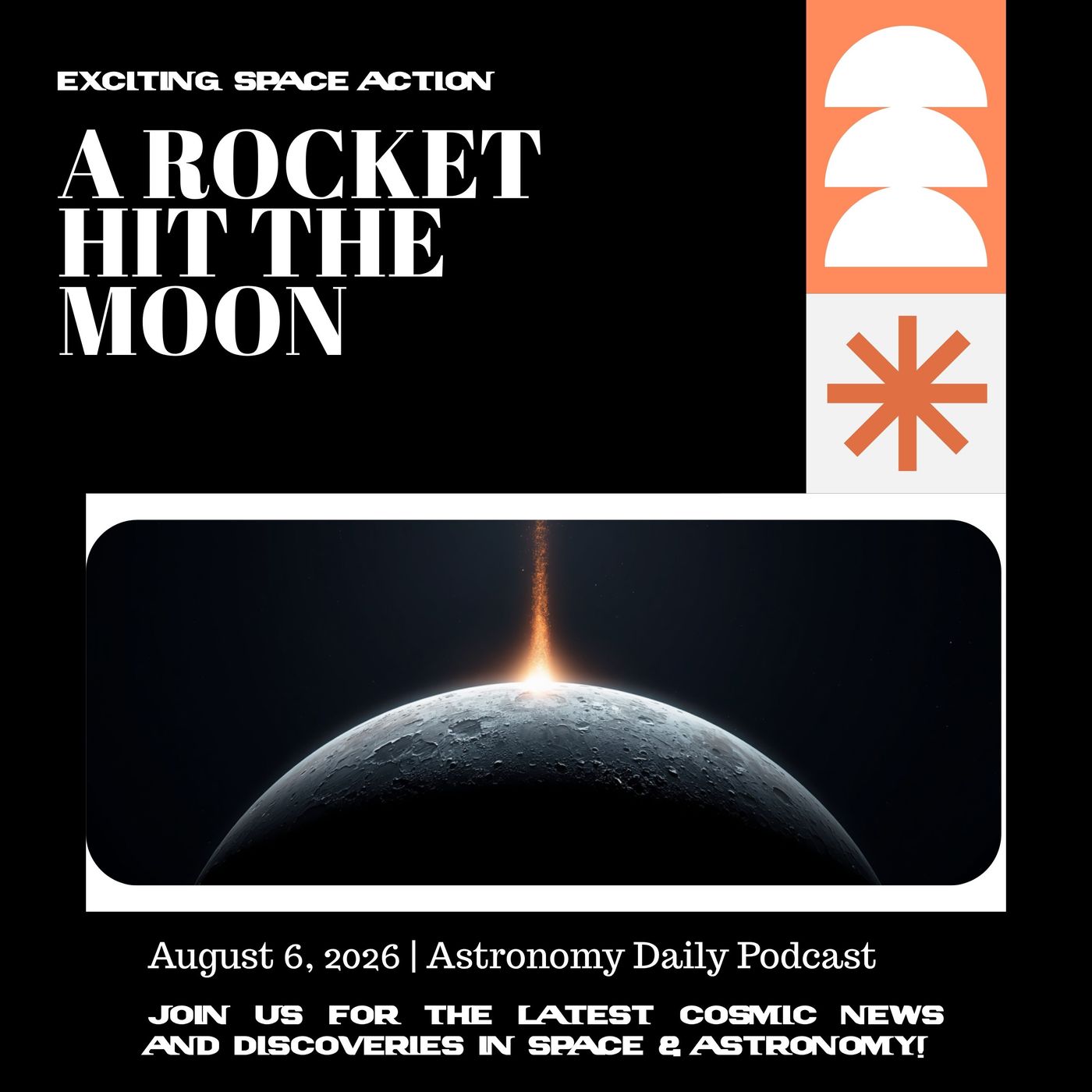
Astronomy Daily · S05E160 · 6 August 2026. In this episode: a Falcon 9 upper stage confirmed to have struck the Moon; a live ISS spacewalk; supernova SN 2026gzf caught at first light; SpaceX Crew-13 previewed; and a both-hemispheres guide to the 12 August eclipse and Perseids.
FALCON 9 LUNAR IMPACT (LEAD) ● Spent upper stage 2025-010D struck near Einstein Crater (~19.4°N, 93.3°W) at ~06:35 UTC, 5 Aug 2026 — matching Bill Gray / Project Pluto predictions. ● ESO’s Very Large Telescope (Paranal) detected sodium and lithium in the impact plume for ~5–10 minutes — sodium from lunar soil, lithium likely from the rocket. ● NASA’s Lunar Reconnaissance Orbiter holds a pre-impact baseline and will image the fresh crater, giving a rare before-and-after dataset to validate hollow-body impact models for future landers. ● Origin: Falcon 9 launched 15 Jan 2025 with Firefly Blue Ghost 1 and ispace Resilience; the stage was left adrift and returned unplanned via solar activity and gravity. ● Sources: NASA; ESO / VLT; CNN; Project Pluto (projectpluto.com); Fernando et al., arXiv:2607.14625.
ISS SPACEWALK — U.S. EVA 96 ● NASA’s Jessica Meir (Expedition 75 commander) and Anil Menon; ~6.5 h EVA beginning ~08:35 EDT, 6 Aug; live on NASA+. ● Task: reconfigure the 3B power channel to accept a seventh roll-out solar array later in 2026 — part of station upkeep ahead of the planned 2030 deorbit. ● Menon’s first spacewalk; two further EVAs scheduled 13 and 25 Aug. ● Sources: NASA / NASA+ ; NASA ISS blog.
SUPERNOVA SN 2026GZF ● X-ray “shock breakout” (EP260321a) detected by China’s Einstein Probe on 21 Mar 2026 from a galaxy ~500 million light-years away; follow-up revealed a broad-lined Type Ic supernova. ● Unusually, no gamma-ray burst and no lasting relativistic jet — and the faintest shock breakout yet linked to this class; a possible missing link between ordinary and GRB-producing supernovae. ● Follow-up used NSF NOIRLab facilities including DECam and the Vera C. Rubin Observatory. Two teams: O’Connor et al. (CMU) and Rastinejad et al. (UMD), in ApJL. ● Sources: NSF NOIRLab; Carnegie Mellon University; The Astrophysical Journal Letters.
SPACEX CREW-13 ● Targeting NET 12 Sep 2026 aboard Crew Dragon Grace from SLC-40, Cape Canaveral. ● Crew: Jessica Watkins (NASA, cmdr — first NASA astronaut to fly Dragon twice), Luke Delaney (NASA, pilot), Joshua Kutryk (CSA), Sergey Teteryatnikov (Roscosmos). 180-day stay; moved up from November. ● Sources: NASA; SpaceX; Houston Public Media.
SKYWATCH — 12 AUGUST & BEYOND ● Total solar eclipse 12 Aug: totality across E Greenland, W Iceland, N Spain and NE Portugal (max 2m18s). Partial across northern US (Alaska–N Carolina), most of Canada, much of Europe and NW Africa. NASA livestream from 1:15 pm EDT. ● US partial highlights: Presque Isle ME ~29% (contiguous-US max); NYC ~9% from ~1:07 pm EDT; Boston ~16%; Toronto ~8%; Montreal ~18%; St John’s ~53%. ● Perseids peak 12–13 Aug under a new Moon (northern-favoured, up to ~100/hr from dark northern sites). ● Southern Hemisphere: pre-dawn planet parade (Saturn best, near opposition; Mars, Mercury, Uranus, Neptune), brilliant Venus in the evening west, and the winter Milky Way high overhead. ● Look-ahead: deep partial lunar eclipse 28 Aug (96% umbral), favouring the Americas. ● SAFETY: use only ISO 12312-2 certified eclipse glasses / solar filters during any partial phase. ● Sources: NASA; ESA; Sky & Telescope; BBC Sky at Night; EarthSky; timeanddate.com; The Planetary Society.
Become a supporter of this podcast:
https://www.spreaker.com/podcast/astronomy-daily-latest-space-news--5648921/support.