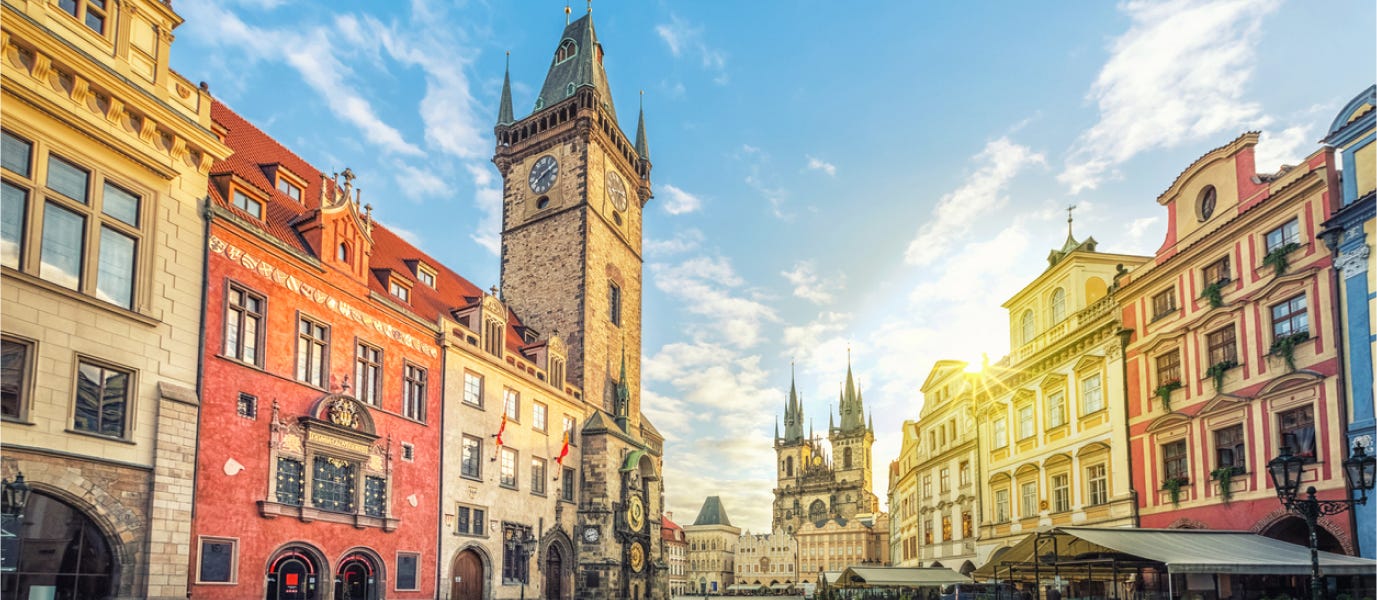
I am writing today’s dispatch from Prague Airport, on my way back to Blighty. What a splendid city Prague is, and what a lovely bunch the Czechs are. It feels like this is still very much a high-trust society. Twice I left my bag in public places – full of very nickable laptop, passport and other gubbins – and both times I came back to find my bag untouched, but safely put to one side. At night the city felt safe. It was very clean – I actually started looking out for litter and I couldn’t see any anywhere, whether in the centre or the suburbs, where I was staying. I always think litter – or lack thereof – is a good indicator of how much people really care about their surroundings, how loyal to and invested in their area they feel, and, indeed, how well brought up they are. The Czechs were lovely: polite, hard-working, respectful, full of ambition and drive, and good looking. The story is that Hitler went to university in Prague and loved the place that so much that, when the Nazis invaded in 1939, he ordered that the city should not be bombed but preserved. I heard the story last time I was here, and heard it again this time. But then I just fact-checked this story and apparently it is total rollocks - Hitler never went to university anywhere, nor did he visit Prague. Perhaps the city survived because the Czechs decided not put up any resistance, so the Nazis went unopposed, which meant they didn’t need to bomb anything. In any case, the city is preserved and you can feel the history as you stroll about the stunning centre. It makes you cry for all the cities that did get flattened in WWII and the memories that disappeared with them. The food was lovely. So was the beer. I even had a couple. All in all, travel, board and lodging cost half of what they do in London, I’d say, at a guess. Just as I did last time I was here, I came away enamoured with the place, feeling that I must come back soon. As for the conference itself, BTC Prague, there were a few GenXers and Boomers – including my new friends Larry Lepard ( check out his book ), James Lavish ( check out his fund ) and George Bodine ( check out his art) – as well as myself – but 85%+ of attendees were under 50, I’d say, with a large chunk under 30. If you are young, starting out and wondering what to do, I would urge you to get involved with the Bitcoin movement. There are so many different ways to do so, depending on where your talents, skills or interests lie. You can be artist, scientist or journalist, engineer, entrepreneur, traveller or surfer-dude. It really doesn’t matter. You’ll find a path that suits you. It all feels so dynamic and full of opportunity. It’s brim full of doers. Everyone is so supportive. There is plenty of capital to invest. You can make quick progress. Another thing to note: there are a lot of extremely clever people in this movement. Average IQ levels in Bitcoin are, I’ve little doubt, much higher than you typically find elsewhere. Conversation, naturally, was dominated with talk of the bitcoin treasury companies , and the incredible price action we are seeing there. To use the baseball analogy, which innings of 9 are we in? I generally made the case that we are in perhaps 5 or 6, with Michael Saylor and MicroStrategy (NASDAQ:MSTR) in 2020 having been innings one. Some of the old-timers - who, it has to be said, have missed this particular wave - dismissed it as the ICO or DEFI craze of this cycle. They may have a point. But James Van Straten, the bright young mind behind the transformation of Coinsilium (AQUIS:COIN ) , told me in no uncertain terms that, as far as the UK is concerned, ball one of innings one has only just be thrown. There is £1.2 trillion of capital in UK pensions and ISAs and, thanks to the FCAs anti-bitcoin rulings, several years of pent-up demand. We shall see. What’s different between this and ICO/DeFi madness is that the bitcoin treasury companies are holding something real and strong, while the narrative is only just getting going. People were very kind about my presentation, and I got asked to do a second one the following day, which I hurriedly wrote. I’ll share both with you as soon as I get the vids, but my main arguments were: * With the changing nature of the global workforce, the rise of the gig and freelance worker, especially the digital nomad (billions of people will soon be on the move), demand for borderless money and portable wealth is inevitably going to grow. * Save strong currencies; spend weak ones. * By investing in bitcoin (the currency), you benefit from the cumulative, combined IQ of everyone involved in Bitcoin (the movement). * With such extraordinary potential, the risk is not so much owning bitcoin as not owning it. As you would expect from someone with my chequered past , I threw in lots of jokes as well. Join this amazing movement. But the main event was the Michael Saylor presentation on Saturday afternoon. My goodness me, the 60-year-old former aerospace engineer has becom