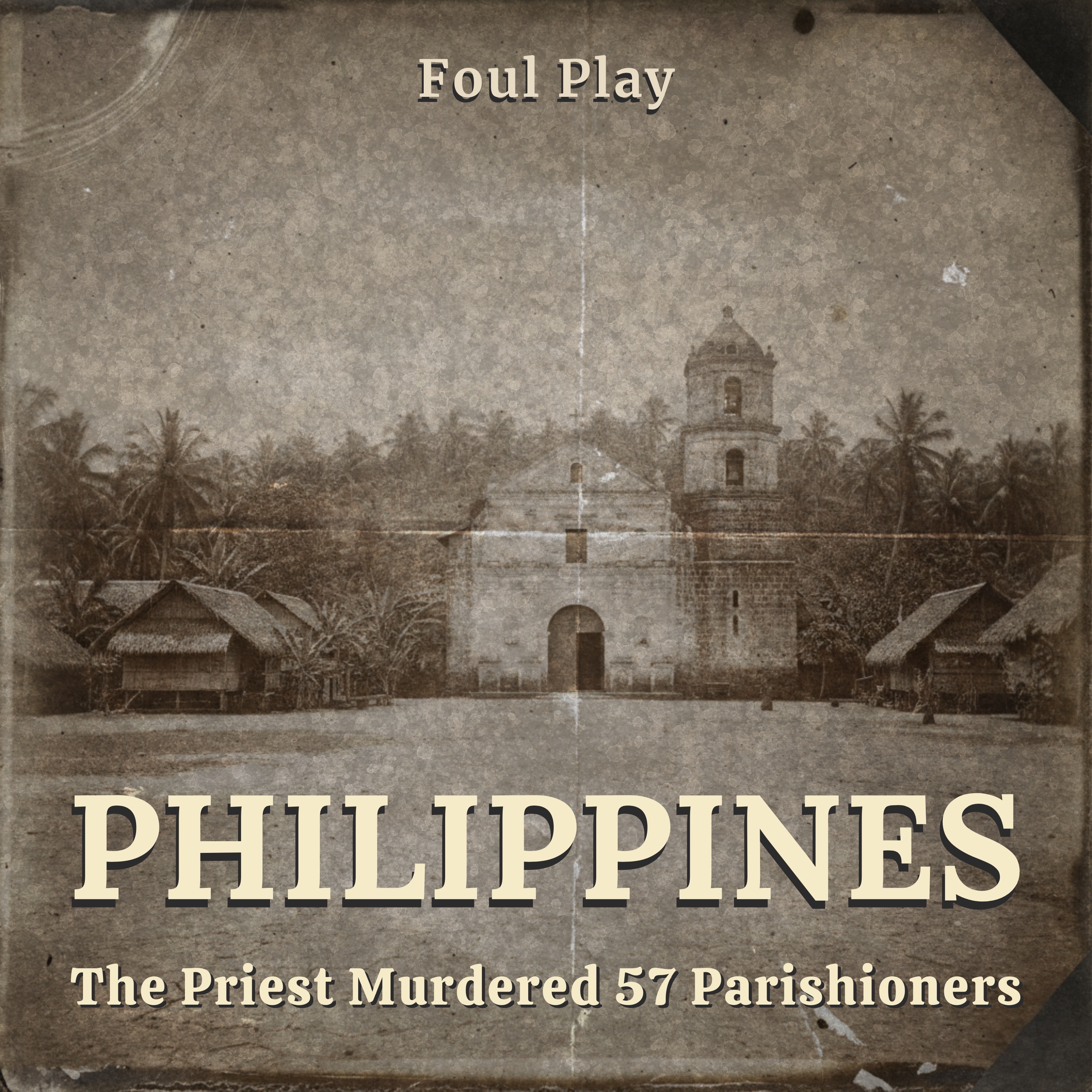
In 1826, fellow priests caring for an ailing Father Juan Severino Mallari made a horrifying discovery in his residence: bloodstained clothing belonging to dozens of missing parishioners. Over the next ten years, investigators would uncover fifty-seven murders committed by the parish priest of Magalang, Pampanga—a man who believed killing his congregants would break a curse afflicting his mother. Father Mallari's victims trusted him completely. They came to him for confession, for blessings, for spiritual guidance. And then they disappeared. What makes this case even more tragic is that Spanish colonial authorities meticulously documented Mallari's education and artwork, but never bothered to record a single name of the fifty-seven Filipinos he murdered. This is the story of colonial erasure, untreated mental illness, and a murderous priest. This is Episode 7 of Season 36: Serial Killers in History , our ambitious exploration of forgotten murderers from ancient Rome through the early 20th century. This season examines how social inequality, colonial systems, and institutional failures enabled killers across continents and centuries. Juan Severino Mallari's case reveals the devastating intersection of Spanish colonial racism, primitive mental healthcare, and religious authority in early 19th-century Philippines. The next episode continues our journey through history's darkest moments with another case of power, isolation, and the victims erased from official records. Historical Context & Background Juan Severino Mallari was born in 1785 in San Nicolas, Pampanga, into a respected Kapampangan family with church benefactor status. He earned his philosophy degree around 1800, his theology degree in 1805 at San Carlos Seminary, and was ordained at the University of Santo Tomas in 1809 by Archbishop Juan Antonio Zulaybar. But being a Filipino priest in Spanish colonial Philippines meant systemic discrimination. From 1809 to 1812, Mallari served as coadjutor in multiple parishes, applying repeatedly for parish priest positions in Orani, Mariveles, Lubao, and as chaplain at the Port of Cavite. Spanish authorities rejected him every time—not for lack of qualifications, but due to colonial racism that viewed Filipino secular priests as inferior to Spanish friars. Finally, in 1812, he became parish priest of San Bartolome Parish in Magalang, the first Filipino to hold that position in all of Pampanga. In that isolated agricultural community, trusted completely by his parishioners, Father Mallari would commit fifty-seven murders over the next decade. The Descent into Madness Around 1816, four years after becoming parish priest, Mallari's mother fell gravely ill. He became convinced she was cursed—a belief that merged Catholic faith with pre-colonial Filipino traditions about mangkukulam (witches) who could cast deadly kulam (curses). Historical accounts describe Mallari experiencing severe hallucinations during Mass, stopping mid-sermon to converse with invisible figures. Spain had pioneered psychiatric treatment in Europe, and the Hospicio de San Jose psychiatric facility in Manila had been operational since 1811. But Mallari was in rural Pampanga, miles from Manila, and he was the parish priest—the highest religious authority in Magalang. No one recognized his psychotic delusions as treatable illness requiring intervention. When Mallari decided that killing the people he believed were witches would cure his mother, no one stopped him. His first victim likely came to confession in 1816. We don't know this person's name, age, or family situation—Spanish colonial records didn't consider such details worth documenting. The Ten-Year Killing Spree Over the next decade, Father Mallari murdered fifty-seven of his parishioners. He killed in the privacy of the parish house—people who came for spiritual guidance, to arrange marriages, to request baptisms. After each murder, he carefully folded the victim's bloodstained clothing and preserved it in his residence. This level of organization existing alongside complete psychotic delusion reveals the terrifying complexity of his mental state. His mother died December 4, 1825. The killings hadn't saved her. Everything had been for nothing. But Mallari didn't stop because of his mother's death—he stopped because sixteen days later, several families finally gathered courage to file a formal complaint with the gobernadorcillo (town mayor). Imagine the bravery required: Filipino families in 1825 Spanish colonial Philippines accusing the parish priest—the most powerful religious figure in their town. In February 1826, when Mallari fell ill and fellow priests came to care for him, they discovered the horrifying evidence: bloodstained belongings of dozens of missing parishioners, folded and stored in his residence. Word reached the constabulary. Townspeople gathered with torches. Ten years of disappearances converged on that moment. Investi