Bulletproof or Broken- Why 'Perfect Form' Is a Lie Episode Summary In this comprehensive episode, we dismantle the pervasive myth that the human body is a fragile machine susceptible to catastrophic injury from minor technique flaws. This narrative, often perpetuated by social media influencers screaming "Snap City," creates widespread fear avoidance behavior (kinesiophobia) that does more harm than good. By reviewing extensive epidemiological data, we demonstrate that obsessing over "perfect" technique has virtually zero correlation with injury risk. Instead, we explore the true drivers of pain and injury: improper load management (doing too much, too fast) and hyper-specialization (lack of movement variability). We also introduce the REP Model (Repeatable, Efficient, Points of Performance) as a practical compass for movement and provide a new framework for staying healthy: focus on robustness and managing your training dose, not fear-based mechanics. Timestamps 00:00:00 - The Fragility Myth: The Body-as-a-Car Metaphor and the Nocebo Effect. 00:11:31 - Defining Injury: Why the scientific data is a methodological mess. 00:21:46 - Injury Rates Compared: The Gym vs. Running vs. Contact Sports. 00:33:32 - MRI is a Liar: Understanding asymptomatic abnormalities ("wrinkles on the inside"). 00:39:10 - The Body-as-a-Bank-Account: A better analogy for capacity and load. 00:41:59 - Suspect 1: Heavy Weight. (Verdict: Innocent). 00:45:44 - Suspect 2: Orthopedic Cost & Exercise Selection. (Verdict: Innocent). 00:49:53 - Suspect 3: Hyper-Specialization. (Verdict: Guilty). 00:54:23 - Suspect 4: Movement Speed. (Verdict: Innocent). 00:57:21 - Suspect 5: Age. (Verdict: Innocent - The "Old Man Strength" phenomenon). 01:02:17 - Suspect 6: Anabolic Steroids. (Verdict: Guilty-ish). 01:04:38 - Suspect 7: Accidents & Gravity Events. (Verdict: Guilty). 01:08:22 - The Myth of the "Robotic" Elite Lifter: Why variability is a feature, not a bug. 01:15:48 - The REP Model: A new framework for technique (Repeatable, Efficient, Points of Performance). 01:20:01 - Conclusion: Your marching orders. ⭐ Get More Value: Exclusive Content and Resources Want to support the show and get early, ad-free access to all episodes plus exclusive bonus content? Subscribe to Barbell Medicine Plus and get ad-free listening, product discounts, and more. Try it free for 30-days. Unsure which training plan is right for you? Take the free Barbell Medicine Template Quiz to be matched with the ideal program for your goals and experience level. For media, support, or general questions, please contact us at
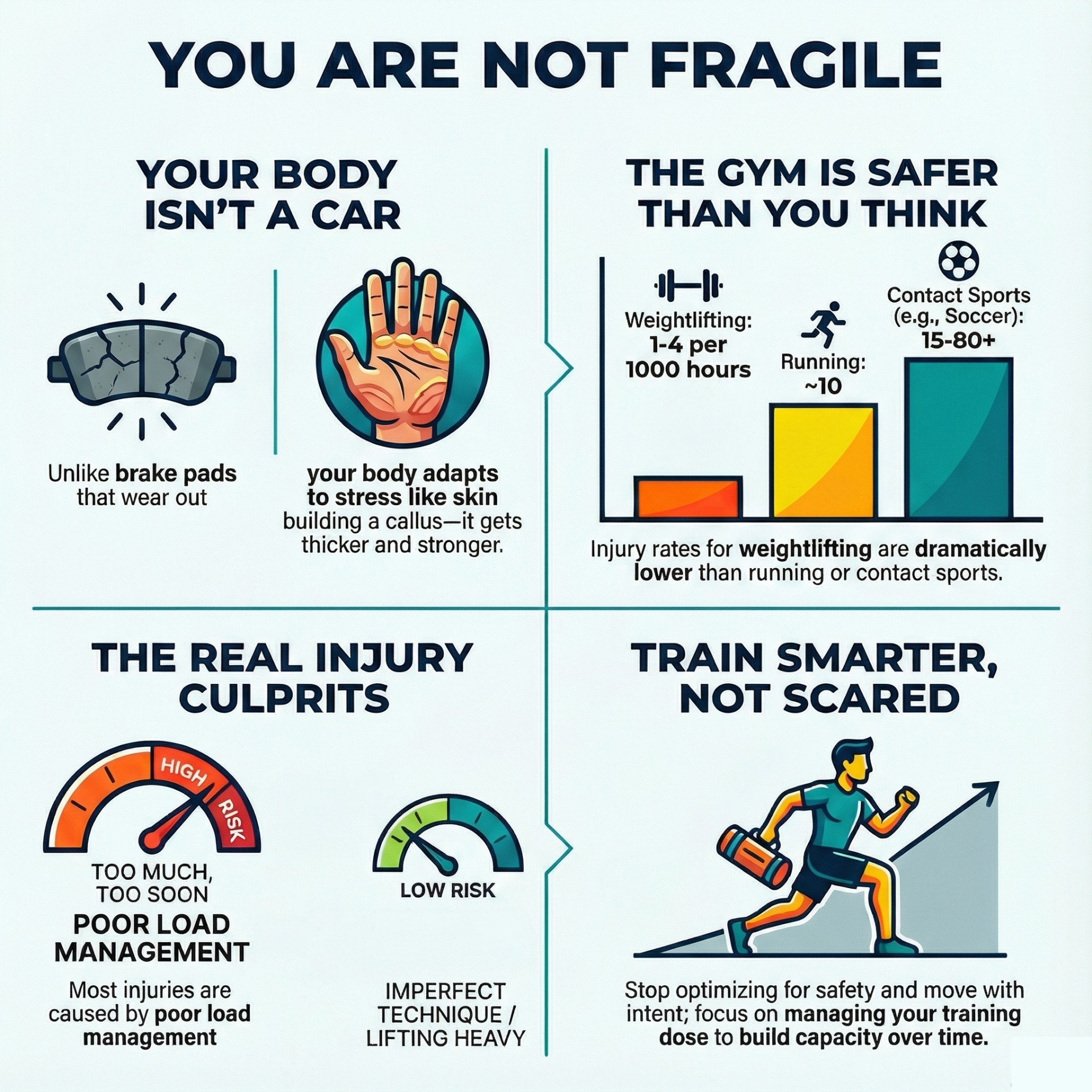
[email protected] Action plan : https://www.barbellmedicine.com/injury-risk-action-plan/ I. The Fragility Myth: Why You Are Not a Car The fitness industry has long relied on the "body-as-a-machine" metaphor to explain pain. The logic suggests that if your alignment is off—much like a car with bad wheel alignment—your parts will wear out and fail. This has led to a culture of fear where athletes spend 30 minutes warming up rotator cuffs or obsessing over a single degree of spinal flexion during a deadlift. However, this mechanical model is fundamentally flawed. Unlike a car, human tissues are adaptable . The Brake Pad vs. The Callus: If you drive a car daily, the brake pads get thinner until they break. If you expose your skin to a barbell daily, it doesn't wear away; it builds a callus. Wolf’s Law & Davis’ Law: Bones get denser, and tendons/ligaments thicken when exposed to appropriate stress. The Nocebo Effect The greatest risk in the gym isn’t a rounded back; it’s the nocebo effect. This is the phenomenon where negative expectations or beliefs lead to negative outcomes. When influencers draw red lines on videos and catastrophize movement, they are socially transmitting pain and fear. This "socially transmitted kinesiophobia" convinces you that you are fragile, leading to hyper-vigilance and, ironically, a higher sensation of pain. Key Takeaway: You do not need to be fixed. You are robust and adaptable. The industry profits from your fragility, but the science supports your resilience. II. The Data Hierarchy of Risk To understand the true risk of the gym, we must look at the epidemiology of injury. Unfortunately, the scientific community struggles to agree on a definition of "injury." Some studies count a stubbed toe, while others only count surgery. Despite this methodological mess, the trends in the data are clear: The gym is one of the safest places to be. Injury Rates by Activity (Per 1,000 Hours) Bodybuilding: 0.2 – 1.0 Powerlifting / Weightlifting: 1.0 – 4.0 Running: ~10 (Novices up to ~18) Field Sports (Soccer, Rugby): 15 – 80+ Motocross: >90 The perception that lifting heavy weights is dangerous while recreational sports are "safe fun" is backward. The gym is a controlled environment where you dictate the load, tempo, and rest. In contrast, fiel